
AI Generated Summary
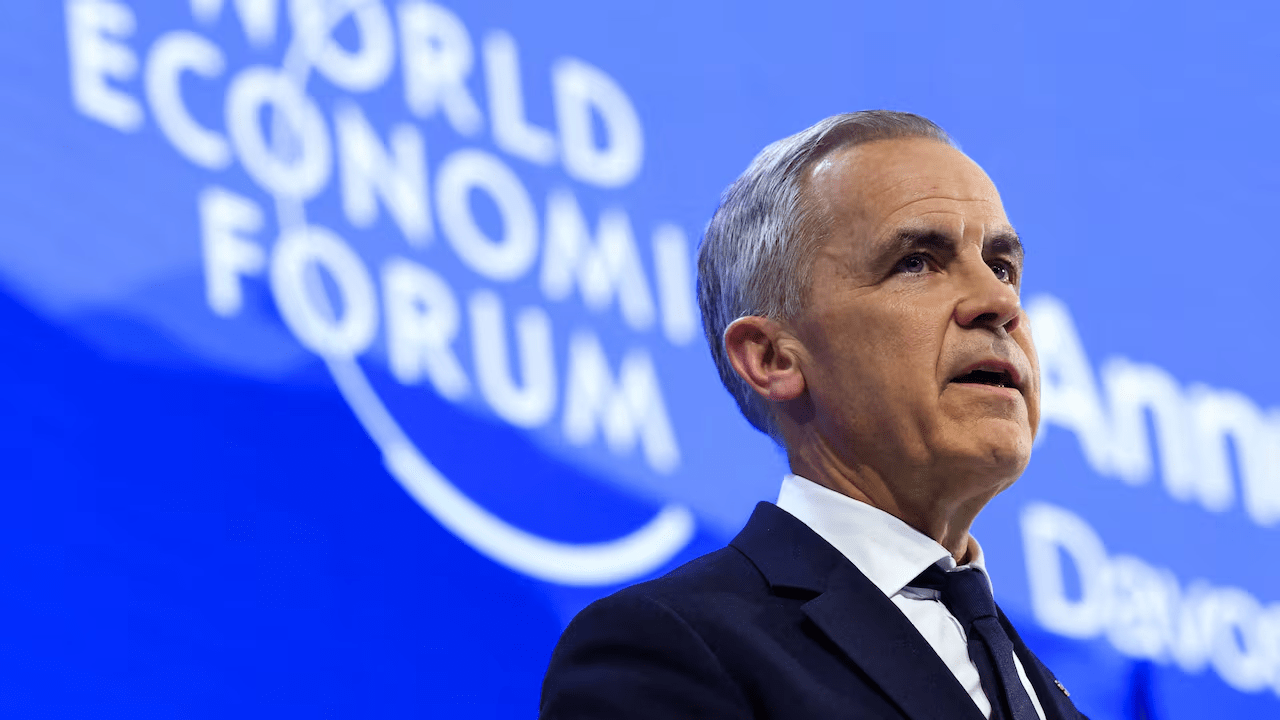
- In a bold and unflinching address at the World Economic Forum in Davos on January 20, 2026, Canadian Prime Minister Mark Carney delivered what many are calling a eulogy for the post-World War II international system.
- ” His remarks, delivered just a day before US President Donald Trump was set to take the stage, mark a significant pivot in global discourse, challenging the foundational myths of American hegemony and urging a reevaluation of international alliances.
- Carney’s rejection of the US-led order resonates deeply with the Global South – the collective of developing nations in Asia, Africa, Latin America, and the Pacific that have long critiqued the inequities baked into the post-1945 global architecture.
In a bold and unflinching address at the World Economic Forum in Davos on January 20, 2026, Canadian Prime Minister Mark Carney delivered what many are calling a eulogy for the post-World War II international system. Speaking amid escalating tensions between the United States and its allies over issues like trade coercion and territorial disputes, Carney declared that the US-led “rules-based international order” is not merely fading but has undergone an irreversible “rupture.” His remarks, delivered just a day before US President Donald Trump was set to take the stage, mark a significant pivot in global discourse, challenging the foundational myths of American hegemony and urging a reevaluation of international alliances.
In an era of great power rivalry, Canada is choosing to be principled and pragmatic. To name reality, to act together, and to build what we claim to believe in. pic.twitter.com/ytZKt6sRyw
— Mark Carney (@MarkJCarney) January 20, 2026
Carney’s speech was prompted by recent US actions, particularly President Trump’s threats to impose tariffs on nations refusing to support America’s controversial push to annex Greenland from Denmark. Framing the current geopolitical landscape as one of “great power rivalry,” Carney argued that the era of economic integration as a force for shared prosperity has given way to weaponized trade and coercion. “Let me be direct: we are in the midst of a rupture, not a transition,” he stated. “The old order is not coming back.”
He described the rules-based order as a “pleasant fiction” – a narrative that was “partially false” from the start. According to Carney, powerful states, led by the US, have long exempted themselves from the rules they enforced asymmetrically on others, using global finance, tariffs, and market access as tools of pressure rather than cooperation. “We knew the story of the international rules-based world order was partially false, that the strongest would exempt themselves when convenient, that trade rules were enforced asymmetrically,” he said. This bargain, he emphasized, “no longer works.”
Carney called on middle powers like Canada to abandon nostalgia and build resilience through diversification, stronger regional alliances, and reduced dependence on US-dominated systems. He explicitly rejected bilateral negotiations with hegemons, warning that such approaches only amplify weakness, and instead advocated for coalitions rooted in sovereignty, realism, and shared values. In a pointed stand, Carney affirmed Canada’s support for Greenland and Denmark, opposing economic coercion and signaling a broader rejection of US unilateralism.
Carney’s rejection of the US-led order resonates deeply with the Global South – the collective of developing nations in Asia, Africa, Latin America, and the Pacific that have long critiqued the inequities baked into the post-1945 global architecture. For decades, these countries have argued that institutions like the World Bank, IMF, and WTO, while ostensibly neutral, have privileged Western interests, enforcing structural adjustments, unequal trade terms, and resource extraction that perpetuate poverty and dependency. Carney’s acknowledgment that the rules-based order was a “lie” – with selective enforcement and asymmetric benefits – validates these criticisms and signals a potential shift toward a more multipolar world.
This is significant for several reasons. First, it could embolden Global South nations to demand reforms in global governance. With a prominent Western leader like Carney admitting the system’s flaws, movements for debt relief, fairer trade, and climate justice – issues where the Global South bears disproportionate burdens – gain legitimacy. For instance, countries in Africa and Latin America, often caught in US-China rivalry, might find new leverage in forming alliances with middle powers like Canada, India, or Brazil, reducing vulnerability to great-power coercion.
Second, Carney’s call for diversification away from US dependency aligns with the Global South’s push for economic sovereignty. Many nations have already pivoted toward initiatives like China’s Belt and Road or regional blocs such as BRICS, seeking alternatives to dollar-dominated finance and US sanctions. If middle powers follow Carney’s lead, this could accelerate de-dollarization and foster South-South cooperation, potentially leading to more equitable global trade and investment flows.
Finally, in the context of ongoing crises like climate change and resource scarcity – exemplified by the Greenland dispute, which involves rare earth minerals critical for green technologies – Carney’s stance highlights the risks of hegemonic control over strategic assets. For the Global South, rich in resources but often exploited, this rupture offers an opportunity to negotiate better terms, ensuring that the “new order” Carney envisions is “more just” and inclusive, rather than a repackaged form of dominance.
While Carney’s speech has been hailed as “his most significant” by observers, skeptics question whether it will translate into action. Canada, after all, remains deeply integrated with the US economy. Yet, as Trump prepares his Davos rebuttal, the address underscores a growing fracture in the Western alliance. For the Global South, this moment is a reminder that the old order’s collapse, though chaotic, could pave the way for a fairer global system – one where their voices are not just heard but heeded. As Carney put it, “From the fracture, we can build something better, stronger, and more just.” The world watches to see if that promise materializes.