


AI Generated Summary
- In a post on its official social media handle, the Army said the successful demonstration marked an important advance in the development of electronic warfare-resilient drone systems.
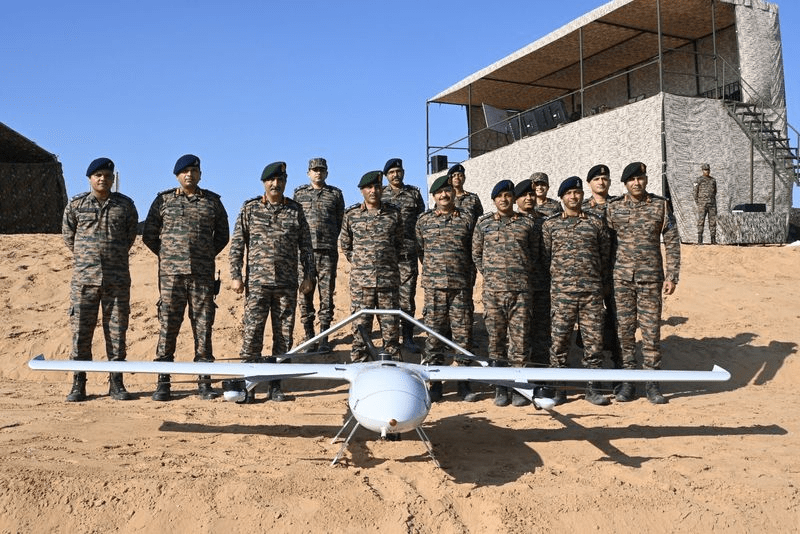
- The test was conducted on Friday at the Mahajan Field Firing Ranges in Rajasthan by the artillery division of the Kharga Corps, under the Army’s Western Command.
- The drone, a fixed-wing platform with an operational range of around 100 kilometres, has been developed through a collaboration between Chennai-based start-ups and Army engineers from the artillery arm.
The Indian Army has taken another step towards strengthening its indigenous drone capabilities with the successful trial of a new long-range unmanned aerial system that is designed to operate even under intense electronic warfare conditions.
The test was conducted on Friday at the Mahajan Field Firing Ranges in Rajasthan by the artillery division of the Kharga Corps, under the Army’s Western Command. The drone, a fixed-wing platform with an operational range of around 100 kilometres, has been developed through a collaboration between Chennai-based start-ups and Army engineers from the artillery arm.
Senior military leadership observed the trial, which the Army described as a significant milestone in its push for self-reliance in critical technologies. In a post on its official social media handle, the Army said the successful demonstration marked an important advance in the development of electronic warfare-resilient drone systems.
Unlike conventional unmanned platforms that rely heavily on continuous radio links and satellite-based navigation, the newly tested drone is designed to function in contested electromagnetic environments. Modern battlefields increasingly see adversaries attempting to jam, spoof or hijack drones by targeting their communication frequencies or GPS signals, often rendering them ineffective or even turning them against their operators.
To counter such threats, electronic warfare-resilient drones use a combination of advanced technologies. These include artificial intelligence-driven mission control, on-board computing, visual and inertial navigation systems, and pre-programmed flight paths that allow the drone to complete its task without constant external inputs. Anti-jamming communication techniques such as frequency hopping, low-probability-of-intercept signals and mesh networking further enhance survivability, while alternative control options can reduce vulnerability to electronic attacks.
The emphasis on such systems reflects the changing nature of warfare. Drones have become indispensable tools for surveillance, reconnaissance, communication support, logistics and precision strikes. Recent conflicts, including the brief but intense military confrontation between India and Pakistan earlier this year and the ongoing Russia-Ukraine war, have underlined how decisive unmanned systems can be on the battlefield.
Drawing lessons from these engagements, the Indian Army has been updating its operational doctrines and tactical concepts to integrate drones more deeply into combat and support roles. A series of field exercises has been conducted across varied terrains to test and refine the employment of unmanned platforms under realistic conditions.
Over the past few years, the Army has inducted a wide spectrum of unmanned aerial vehicles, ranging from small hand-held tactical drones used by infantry units to larger, long-endurance systems capable of operating deep into enemy territory. These platforms have been integrated across arms and services, including for tasks such as delivering supplies in high-altitude and remote areas.
At the same time, there is growing emphasis on indigenous development. The Army, along with the other services, has been working closely with domestic industry and start-ups to design, develop and manufacture drones tailored to Indian operational requirements. In-house innovation, coupled with enhanced training in drone warfare, is seen as critical to maintaining an edge in future conflicts.
The successful trial in Rajasthan highlights how this approach is beginning to yield tangible results, reinforcing the Army’s broader objective of technological self-reliance while adapting to the realities of modern, technology-driven warfare.