


AI Generated Summary
- Farmers point out that while mustard can be sown from late September to the end of October— and in some cases even till November— the lack of assured procurement discourages them.
- In Moga, the area under mustard and oilseeds has more than doubled in recent years, offering a glimpse of what is possible with targeted support.
- Officials from the state agriculture department note that mustard can be a profitable alternative and that Punjab’s soil is well-suited for the crop.
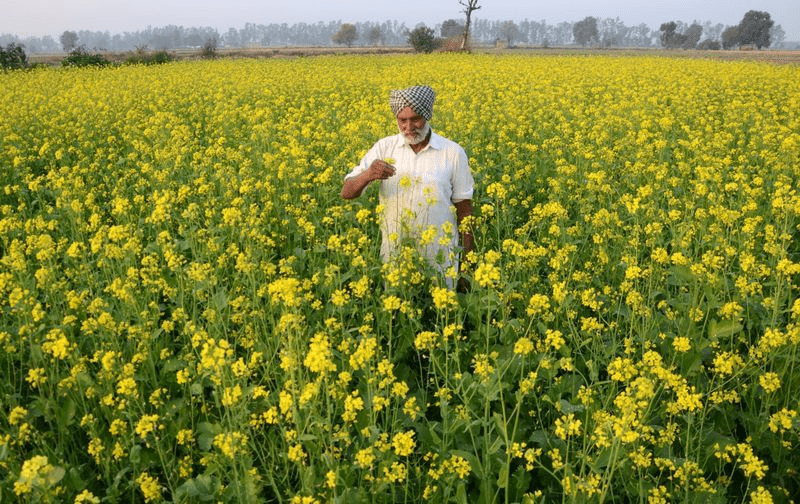
For decades, Punjab’s landscape in winter was painted in gold. Vast mustard fields lined village roads, swayed gently in the breeze, and found a permanent place in popular culture—from folk songs to unforgettable Bollywood visuals. Today, that once-familiar sight is steadily disappearing, driven not by a change in climate but by changing economics.
Despite a steady rise in mustard oil prices across the country, farmers in Punjab are increasingly moving away from oilseed cultivation. Low and uncertain returns, coupled with weak marketing support, have pushed them deeper into the wheat–paddy cycle that dominates the state’s agriculture.
The scale of decline is stark. In the early 1970s, Punjab had nearly five lakh hectares under oilseed crops such as mustard, toria, soybean and sunflower. That figure has now collapsed to just about 51,000 hectares. Of this, mustard accounts for roughly 41,000 hectares, reflecting how marginal the crop has become in a state once known for its vibrant oilseed fields.
Farmers point out that while mustard can be sown from late September to the end of October— and in some cases even till November— the lack of assured procurement discourages them. Brown and yellow mustard, Raya-Toria and Gobhi Sarson are the main varieties grown, with yields generally ranging from six to eight quintals per acre. Under good conditions, some farmers report yields as high as 15 to 16 quintals per acre. Yet the Minimum Support Price, currently around ₹6,200 per quintal, often remains theoretical due to poor government procurement.
The consequence is heavy dependence on imports. Punjab produces barely three per cent of the oil it consumes, importing the remaining 97 per cent. Nationally too, the gap is wide: domestic oil production stands at about 120 lakh tonnes, while imports touch nearly 140 lakh tonnes to meet demand. Rajasthan leads the country in mustard production, followed by Uttar Pradesh, with Gujarat, West Bengal, Haryana and Assam also contributing significantly. Within Punjab, districts like Fazilka, Hoshiarpur, Gurdaspur and Bathinda remain the main pockets of mustard cultivation.
Many farmers believe the problem is not the crop but the system. With no assured government procurement, they are forced to sell to private traders who dictate prices. “If marketing and MSP issues are resolved, farmers will return to mustard,” is a sentiment echoed across villages. The efficient and predictable procurement system for wheat and paddy, they say, is the biggest reason they hesitate to diversify.
There are, however, glimmers of hope. Some farmers who took the risk have seen encouraging results. Gurmail Singh of Maddoke village expanded his mustard cultivation after earning good profits last year, reporting yields close to 16 quintals per acre. Others in Charik and Badhni Kalan have also gradually increased their acreage, convinced that the crop can be rewarding if supported properly. Their main demands are quality seeds at affordable prices and a reliable market.
Agriculture experts back this optimism. Officials from the state agriculture department note that mustard can be a profitable alternative and that Punjab’s soil is well-suited for the crop. Scientists highlight newly developed varieties that promise higher yields and better returns, while district administrations point to schemes under the National Mission on Edible Oils that offer financial assistance for setting up small oil-processing units through farmer collectives.
In some districts, the effort is already showing results. In Moga, the area under mustard and oilseeds has more than doubled in recent years, offering a glimpse of what is possible with targeted support.
As Punjab grapples with depleting groundwater, rising input costs and dependence on imports, the revival of mustard could serve both economic and environmental goals. The golden fields may have faded, but with the right policies and marketing infrastructure, they could yet return—restoring not just a crop, but a symbol deeply woven into Punjab’s rural identity.