


AI Generated Summary
- In an age dominated by digital entertainment and rapidly changing technology, a government primary schoolteacher from Punjab's border district of Ferozepur is working to preserve the physical reminders of a disappearing way of life.
- At a time when older possessions are frequently discarded in favour of modern alternatives, his museum serves as a reminder that cultural history survives not only through books and monuments but also through the seemingly ordinary objects people leave behind.
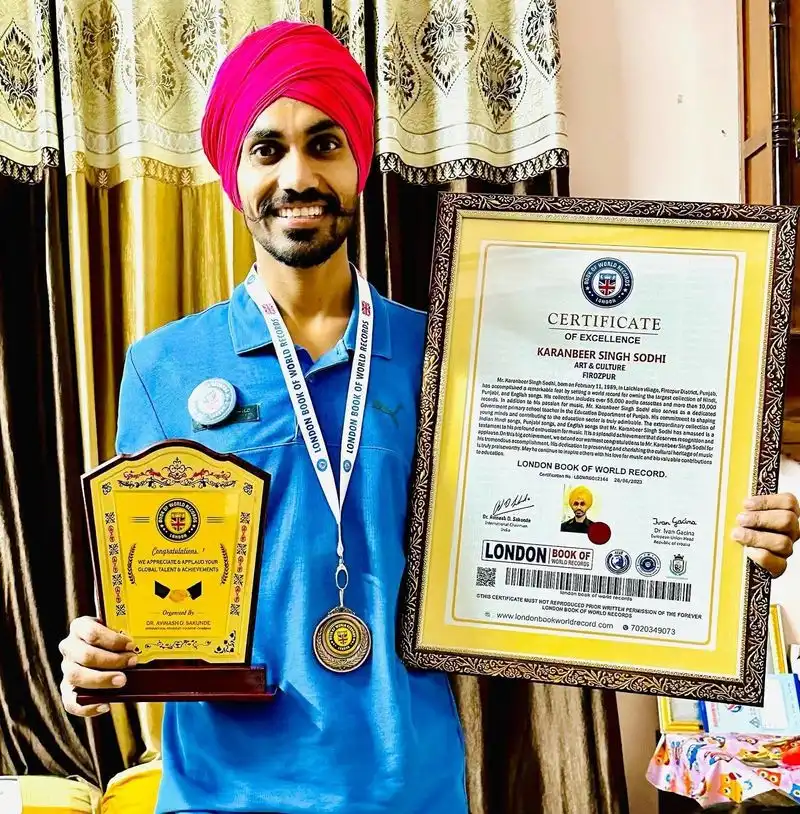
- His remarkable collection and commitment to heritage preservation have earned him recognition from the London Book of World Records, according to a report in The Tribune.
In an age dominated by digital entertainment and rapidly changing technology, a government primary schoolteacher from Punjab's border district of Ferozepur is working to preserve the physical reminders of a disappearing way of life.
Karanveer Singh Sodhi, 37, a resident of Lalchhian village, has transformed his residence into a private museum housing more than 55,000 Punjabi and Hindi music cassettes, alongside vintage electronic equipment, traditional household articles and other historical objects.
His remarkable collection and commitment to heritage preservation have earned him recognition from the London Book of World Records, according to a report in The Tribune.
Sodhi's interest in antiques dates back to his childhood. What began as a fascination with discarded objects gradually developed into a lifelong pursuit. He explored scrap dealers' shops, acquiring articles that might otherwise have been destroyed or lost. In 2016, he established a museum within his residence to preserve his growing collection.
Besides music cassettes, the museum houses old television sets, tape recorders and traditional cast-iron cooking griddles, offering visitors a window into everyday life before the digital revolution.
His collection has attracted interest from visitors across geographical boundaries, including people from overseas. Members of the entertainment industry have also approached him to borrow objects for productions. However, Sodhi has declined such requests, prioritising the safety and preservation of his exhibits over financial gains.
The collection assumes particular cultural significance in Punjab, where music has historically played a central role in documenting social experiences, relationships, rural traditions and collective identity.
Before smartphones and online streaming platforms became ubiquitous, audio cassettes were an important medium through which Punjabi music reached households across the state. They connected listeners with folk traditions, devotional compositions and popular musical expressions.
Similarly, traditional household implements reflect generations of domestic practices that are gradually disappearing with technological advancement and changing lifestyles.
Individual initiatives such as Sodhi's highlight the importance of community-led heritage conservation. While formal museums often focus on major historical developments and rare artefacts, privately maintained collections can help document the everyday experiences of ordinary families.
For younger generations, such collections offer opportunities to understand how their parents and grandparents experienced music, entertainment and domestic life.
Sodhi's work also draws attention to the need for documenting and preserving ageing physical media before it deteriorates beyond recovery.
At a time when older possessions are frequently discarded in favour of modern alternatives, his museum serves as a reminder that cultural history survives not only through books and monuments but also through the seemingly ordinary objects people leave behind.