


AI Generated Summary
- Today, Pul Kanjri stands not merely as a physical remnant of the past, but as a testament to the intersection of art, power and social commentary.
- The legend of Moran and Maharaja Ranjit Singh continues to lend the site a human dimension, reminding visitors that history is often shaped by small moments that leave lasting marks.
- Interpreting it as both criticism and counsel, he ordered the immediate construction of a bridge over the canal.
On the historic route once travelled by Sher-e-Punjab Maharaja Ranjit Singh between Lahore and Amritsar lies a site steeped in folklore, artistry and royal memory. What was once a modest temporary campsite for the Sikh ruler has, over generations, evolved into a symbol of cultural heritage known today as Pul Kanjri.
In the early 19th century, Maharaja Ranjit Singh’s journeys were not merely military or administrative in nature. His halts along the way often transformed into vibrant cultural gatherings, drawing dancers, singers and musicians from surrounding regions. These artistes would assemble near the royal camp to showcase their talents, hoping to earn the Maharaja’s patronage and favour.
Among the many performers associated with these gatherings, folk tradition highlights a dancer named Moran. Stories describe her arriving on horseback, captivating the court with her elegant performances. One incident, preserved through oral history, links Moran directly to the origin of Pul Kanjri.
According to legend, Moran once lost a slipper while crossing a canal near the campsite. When she later appeared before the Maharaja, she declined to dance. On being questioned, she explained that the loss of her shoe had occurred because there was no bridge across the canal. She reportedly added that if even a powerful ruler could not provide such a basic facility, how could travelling performers expect to move with dignity.
The remark is said to have left a deep impression on Maharaja Ranjit Singh. Interpreting it as both criticism and counsel, he ordered the immediate construction of a bridge over the canal. As the structure came into existence at Moran’s behest, it was initially referred to as Pul Moran.
Over time, language and local usage altered the name. In rural dialects, women associated with singing and dancing were often referred to as ‘kanjri’. Gradually, Pul Moran became known as Pul Kanjri — a name that has endured across generations.
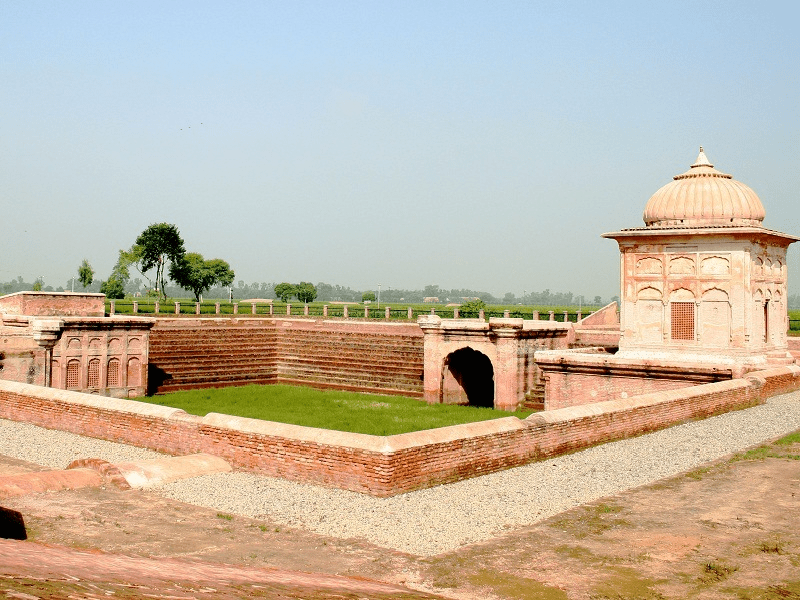
History, however, brought significant changes. With the decline of the Sikh Empire, the Badshahi Canal that once flowed beside the bridge gradually vanished. The bridge itself disappeared as well, leaving behind only remnants of the once-bustling complex. What remains today are a historic tank and a baradari constructed during Maharaja Ranjit Singh’s era, both still standing in surprisingly good condition. The disappearance of the canal also deprived the tank of its water source, rendering it dry.
Recognising its historical and cultural importance, the Punjab Tourism Department has declared Pul Kanjri a protected monument. Efforts to preserve the site have also been supported by Spring Dale Senior School, Amritsar, whose involvement reflects a growing awareness of community responsibility toward heritage conservation.
Today, Pul Kanjri stands not merely as a physical remnant of the past, but as a testament to the intersection of art, power and social commentary. The legend of Moran and Maharaja Ranjit Singh continues to lend the site a human dimension, reminding visitors that history is often shaped by small moments that leave lasting marks.
