


AI Generated Summary
- On the occasion of Gurpurab, each locality should host a single Nagar Kirtan where Sikh scholars pause at various points to narrate the life and history of Guru Sahib to the sangat.
- But at the same time, the Shiromani Committee also took out another Nagar Kirtan from the very same spot at Gurdwara Sis Ganj Sahib—only a few minutes after the Delhi Committee’s Nagar Kirtan had departed.
- The amount of money the Sikh community spends on these Nagar Kirtans could instead educate many needy children, support the weddings of poor daughters, provide employment to the jobless, or fund medical treatment for the sick.
In connection with the tercentenary of Guru Tegh Bahadur Ji’s martyrdom, it seemed as though a race to organize Nagar Kirtans had begun within the Sikh community. The Shiromani Gurdwara Committee organized a Nagar Kirtan from Assam to Anandpur Sahib, while the Takht Patna Sahib Committee conducted one from Patna Sahib to Anandpur Sahib. Similarly, the Delhi Gurdwara Committee brought a Nagar Kirtan from Sri Anandpur Sahib to Delhi.
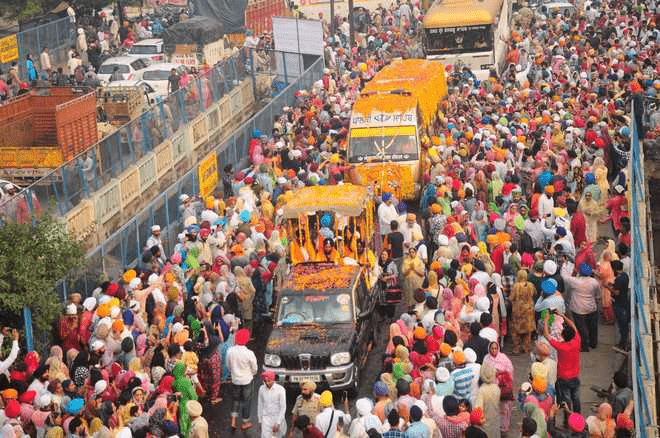
For the first time in history, two Nagar Kirtans were seen on the occasion of Guru Tegh Bahadur Ji’s martyrdom day. One Nagar Kirtan was taken out, as every year, by the Delhi Gurdwara Committee. But at the same time, the Shiromani Committee also took out another Nagar Kirtan from the very same spot at Gurdwara Sis Ganj Sahib—only a few minutes after the Delhi Committee’s Nagar Kirtan had departed. In this way, several other Nagar Kirtans were organized by different institutions. But the real question is: What has the community actually gained from so many Nagar Kirtans?
Guru Tegh Bahadur Ji’s sacrifice is so great that no parallel can ever be found in the world, yet the Sikh community has limited its efforts to mere Nagar Kirtans in the name of spreading awareness.
Earlier, when Nagar Kirtans were taken out, they were true Nagar Kirtans, although people used to call them Sikh processions. Today, although the name remains the same, in reality they resemble processions: only a handful of people walk alongside the Guru Sahib’s palki singing shabad kirtan, while the rest of the Nagar Kirtan is scattered in fragments. Along the streets, countless stalls serving various dishes and blaring loudspeakers openly mock Sikh maryada. Sikh tradition upholds the sanctity of Guru ka Langar, yet at these stalls the sanctity is openly violated—people eat less and waste more.
The amount of money the Sikh community spends on these Nagar Kirtans could instead educate many needy children, support the weddings of poor daughters, provide employment to the jobless, or fund medical treatment for the sick. Sadly, the community today seems more focused on display; few appear willing to walk the path shown by Guru Nanak.
On the occasion of Gurpurab, each locality should host a single Nagar Kirtan where Sikh scholars pause at various points to narrate the life and history of Guru Sahib to the sangat. There should be one proper langar service, where the sangat is served while seated in lines, ensuring that no food is wasted.
