


AI Generated Summary
- From the Prime Minister to the ministers of the Union Government, the message has repeatedly been conveyed that respecting the faith of Sikhs, their religious rights and the heritage associated with the Sikh Gurus is among India’s priorities.
- When it came to their return journey, the Indian government took a humanitarian step and, going beyond the usual border arrangements, opened the Wagah border to facilitate their return to Pakistan.
- Sikhs living in Pakistan are just as deeply connected to the teachings of Guru Nanak Dev Ji, the legacy of the Sikh Gurus and Sikh history as Sikhs living in India.
Some Sikh leaders and organisations based overseas, who frequently criticise Prime Minister Narendra Modi and his government, should perhaps take a closer look at this example of how the Indian government demonstrates respect and sensitivity towards the Sikh community. This respect is not limited to Sikhs living in India; it extends to Sikhs living anywhere in the world, including Pakistan. From the Prime Minister to the ministers of the Union Government, the message has repeatedly been conveyed that respecting the faith of Sikhs, their religious rights and the heritage associated with the Sikh Gurus is among India’s priorities. The sensitivity shown by the Indian government towards a group of Sikh pilgrims from Pakistan is a significant example of this commitment.
The group of Sikh pilgrims from Pakistan wished to visit India’s historic Sikh shrines and meet their relatives and acquaintances living here. They wanted to enter India through the Attari border so that they could complete their journey in less time and at a lower cost. However, the Pakistani government did not grant them permission to travel through the Attari border. As a result, the pilgrims had to consider a longer and more expensive alternative route. They arranged tickets costing lakhs of rupees and planned to travel through several countries to reach India. However, just minutes before their flight was scheduled to depart, the Pakistani government stopped them from travelling. This development left the pilgrims deeply disappointed and sparked considerable discussion and controversy in both countries.
Although permission was subsequently granted for them to visit India, the Attari border route was still not opened for their arrival. On the other hand, when it came to their return journey, the Indian government took a humanitarian step and, going beyond the usual border arrangements, opened the Wagah border to facilitate their return to Pakistan. This gesture set an example before the Sikh community across the world.
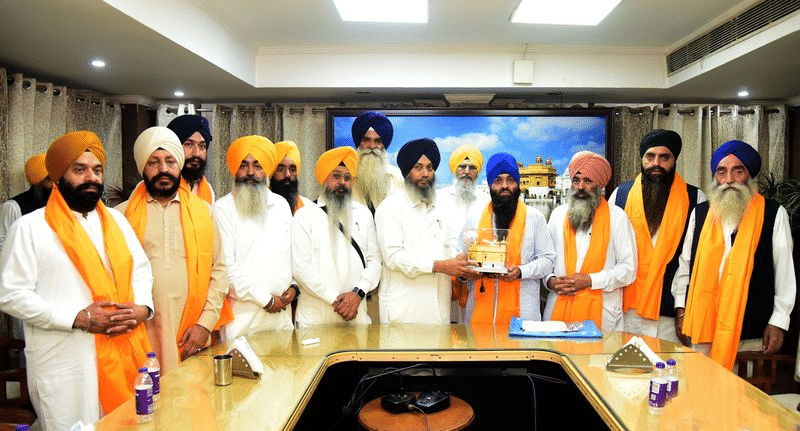
The warmth and respect extended to the Pakistani Sikh pilgrims after their arrival in India must have made their visit a memorable experience. The role played by Delhi Sikh Gurdwara Management Committee President Sardar Harmeet Singh Kalka, General Secretary Sardar Jagdeep Singh Kahlo and, in particular, Sardar Paramjit Singh Chandok deserves special recognition. They maintained continuous coordination with the Ministry of Home Affairs, Government of India, and made significant efforts to secure the necessary permissions and arrangements. When administrative and border-related obstacles threatened to disrupt a religious pilgrimage, these representatives understood the difficulties faced by the pilgrims and worked to find a solution. This demonstrates how positive coordination between Sikh institutions and the government can play a vital role in resolving the difficulties faced by pilgrims.
After arriving in India, the group visited Hemkund Sahib and Sri Darbar Sahib, Amritsar, along with other sacred Sikh shrines. The happiness and satisfaction visible on their faces reflected that this journey was much more than a religious pilgrimage. It was an emotional opportunity to visit the land of their Gurus, reconnect with their heritage and meet their loved ones. Particularly noteworthy were the sentiments expressed by the pilgrims: the assistance and facilities they had expected from their own government were ultimately provided by the Indian government. They expressed heartfelt gratitude to Prime Minister Narendra Modi’s government for this support.
This development also raises an important question for those who view every action of the Indian government negatively because of their political opposition. Does opposing a government mean that even its good work should never be acknowledged? Political differences are an integral part of democracy, but when religious faith, humanity and the convenience of pilgrims are involved, an impartial approach is essential. The arrangements made by the Indian government for Sikhs living in Pakistan demonstrate that respect for the Sikh community should not be restricted by political boundaries or nationality.
Sikhs living in Pakistan are just as deeply connected to the teachings of Guru Nanak Dev Ji, the legacy of the Sikh Gurus and Sikh history as Sikhs living in India. For them, visiting India is not merely a journey to another country; it is an opportunity to reconnect with their religious and historical centres. Facilitating their journey and ensuring that they can pay obeisance at their sacred shrines with dignity is not a favour, but a humanitarian and religious responsibility. On this occasion, the Indian government gave due importance to precisely this sentiment.
The step taken by Prime Minister Narendra Modi’s government should not be viewed merely as granting travel permission or making an administrative arrangement for crossing the border. It sends a message to Sikhs across the world that India values their religious and cultural bonds. By making the journey easier for Sikh pilgrims from Pakistan, the Indian government has demonstrated that respect for Sikhs should not remain confined to speeches and declarations; it must be reflected in concrete action when the need arises. It is this spirit that rises above political criticism and strengthens humanity, religious freedom and mutual brotherhood.