


AI Generated Summary
- By placing women and families at the centre of this effort, the initiative sought to demonstrate that the survival of a language depends not only on its presence in literature and classrooms, but also on its continued use in homes, conversations and stories passed from one generation to another.
- As changing lifestyles and modern communication habits gradually push traditional expressions and oral narratives out of everyday use, a heritage initiative in Amritsar has turned to women as key custodians of Punjab’s linguistic and cultural identity.
- Referring to the literary legacy of Baba Sheikh Farid, he underscored the historical depth of Punjabi and the importance of protecting its diverse linguistic traditions.
INTACH workshop in Amritsar highlights the importance of preserving regional dialects, traditional storytelling and the cultural wisdom of older generations
As changing lifestyles and modern communication habits gradually push traditional expressions and oral narratives out of everyday use, a heritage initiative in Amritsar has turned to women as key custodians of Punjab’s linguistic and cultural identity.
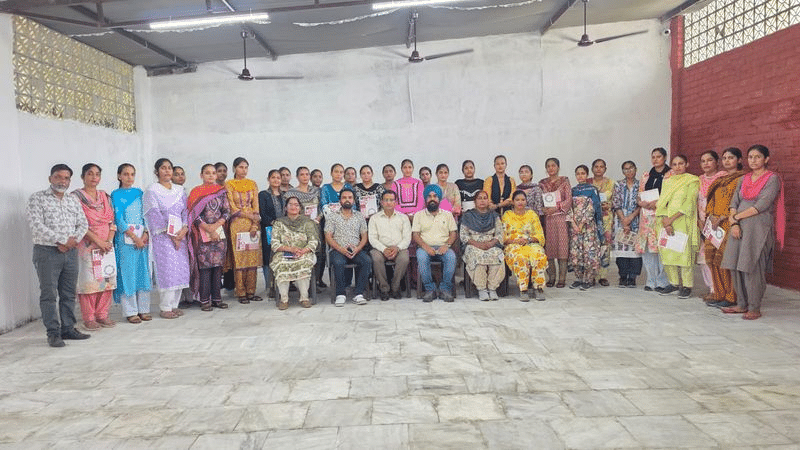
Nearly 60 women came together at Baba Aya Singh Riarki Public School for a Heritage and Citizens Training Workshop organised by the Amritsar Chapter of the Indian National Trust for Art and Cultural Heritage (INTACH). The gathering focused on safeguarding disappearing Punjabi vocabulary, regional dialects and folk traditions that have survived largely through generations of oral storytelling.
Held at the school’s General Manekshaw Conference Hall, the programme was conducted under the aegis of INTACH’s Heritage Education and Communication Service (HECS), New Delhi, and INTACH Punjab. It sought to encourage greater community participation in documenting and preserving the region’s intangible cultural heritage.
A central theme of the discussions was the influence of mothers and grandmothers in shaping children’s earliest understanding of language and culture. Speakers observed that traditional lullabies, household conversations, folk songs and bedtime stories have historically served as informal yet powerful means of passing linguistic knowledge from one generation to the next.
Prof Manpreet Kaur, the school’s Director of Education, emphasised that language preservation must begin within families rather than remain confined to academic institutions. She encouraged students to interact with elderly family members and record traditional expressions, forgotten words and stories that rarely find a place in contemporary conversations.
Such interactions, she noted, could strengthen intergenerational relationships while creating opportunities for children to discover the richness of their mother tongue beyond textbooks.
The workshop also drew attention to the vulnerability of regional dialects, particularly those with limited written documentation.
Delivering the keynote address, Prof Naresh Kumar, Head of the Department of Punjabi and Dogri at Himachal Pradesh University, examined how languages evolve alongside social and cultural changes. He highlighted the need to systematically record dialects such as Dogri and Pothohari, whose distinctive vocabulary and expressions risk fading as younger generations adopt more standardised forms of communication.
Referring to the literary legacy of Baba Sheikh Farid, he underscored the historical depth of Punjabi and the importance of protecting its diverse linguistic traditions.
The declining practice of family storytelling emerged as another major concern. Historian Mintu Kumar recalled a time when stories narrated by grandmothers formed an essential part of childhood, introducing young listeners to moral values, imagination, courage and the nuances of spoken language.
To revive this tradition, he proposed dedicating one evening every week to storytelling within families. He also suggested that schools organise storytelling competitions to encourage children to engage with narratives inherited from their elders.
Addressing the diversity of spoken Punjabi, linguistic expert Prof Gagandeep Kaur Nagra explored the development of the Majhi dialect and its relationship with standard Punjabi. She explained that differences in pronunciation, vocabulary and conversational expressions across Amritsar, Ludhiana and Jalandhar reflect distinct regional histories rather than any hierarchy of linguistic correctness.
Preserving these variations, she indicated, is essential to understanding Punjab’s broader cultural landscape.
Gagandeep Singh Virk, Convener of INTACH’s Amritsar Chapter, shared details of ongoing initiatives to compile disappearing Punjabi words associated with farming practices, traditional household items, family relationships, food and social customs. Efforts are also underway to bring together folk tales that have gradually slipped out of common memory.
He emphasised that heritage conservation should extend beyond the protection of monuments and historic structures to include the everyday language, memories and customs that define a community.
The workshop concluded with participants committing themselves to preserving and sharing traditional Punjabi expressions and oral narratives.
By placing women and families at the centre of this effort, the initiative sought to demonstrate that the survival of a language depends not only on its presence in literature and classrooms, but also on its continued use in homes, conversations and stories passed from one generation to another.