


AI Generated Summary
- He was a 28-year-old from Jabowal village in Kapurthala who left Punjab as a teenager after his family borrowed around Rs 30 lakh, took the irregular “dunki” route to the United States, and spent the next decade delivering pizza in New York so that a daily-wage household back home might stay afloat.
- A delivery rider in a turban or with a Punjabi name becomes, in the worst neighbourhoods, a visible stand-in for a story the public already thinks it knows.
- It needs a few high-profile arrests, a few temple-yard shootings, a few “referendum” spectacles funded in ways that never quite get audited, and then a pizza boy on a moped in East New York.
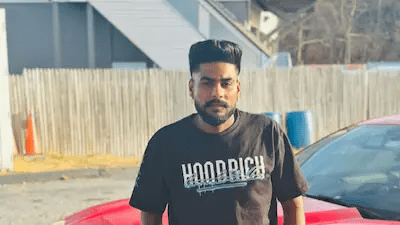
Gurdeep Singh was not a symbol until someone made him one. He was a 28-year-old from Jabowal village in Kapurthala who left Punjab as a teenager after his family borrowed around Rs 30 lakh, took the irregular “dunki” route to the United States, and spent the next decade delivering pizza in New York so that a daily-wage household back home might stay afloat. On the night of 21 August 2026, near Crescent Street and Stanley Avenue in East New York, he was shot multiple times during a street confrontation and died. Surveillance video shows a fight, then gunfire; the other man fled in a car. Police have not announced an arrest. Family accounts speak of a robbery; New York investigators have also examined road rage. The motive is still open. The body is what is certain.
That is the story that should have remained a local crime report. It is being asked to carry more because a young Sikh man from Punjab dying on an American street is no longer treated as an isolated accident of urban violence. A small, loud, and repeatedly documented fringe—drug networks, street gangs, and Khalistan extremists operating in parts of the diaspora—has spent years giving Western police, tabloids, and neighbourhoods a ready-made script. Ordinary workers then inherit the script.
The numbers are not mysterious. In Canada, where the Sikh population is a tiny share of the country, Punjabi-origin gangs have for years accounted for a grossly disproportionate slice of gang homicides and of the cocaine, methamphetamine, and fentanyl trade moving through British Columbia and beyond. Canadian and Indian reporting has repeatedly described the same pattern: young men recruited from Punjab villages, trucking and warehouse networks used as cover, proceeds recycled into guns, luxury display, and, in documented cases, into the logistics of separatist rallies and legal funds. Indian agencies have published lists of wanted gangsters with overseas bases; a non-trivial share sit in Canada and the United States. Analysts have said the same thing in plainer language: some criminals wrap themselves in the Khalistan flag because it launders a rap sheet into a political cause.
That fringe is not “the Sikh community.” It is a handful of networks that have been allowed, in too many Western cities, to treat gurdwaras, student groups, and refugee pipelines as recruitment pools. The cost is paid by people who have nothing to do with them. A delivery rider in a turban or with a Punjabi name becomes, in the worst neighbourhoods, a visible stand-in for a story the public already thinks it knows: drugs, gangs, separatism, trouble. Collective suspicion does not need a manifesto. It needs a few high-profile arrests, a few temple-yard shootings, a few “referendum” spectacles funded in ways that never quite get audited, and then a pizza boy on a moped in East New York.
Gurdeep Singh does not fit that story. He was unmarried, still carrying family debt, hoping for a green card, planning a visit home. His father is a daily-wage worker waiting for a corpse. Treating his death as proof of a hate wave would be as sloppy as pretending the gang–drug–extremist overlap does not exist. Both errors serve the same people: the criminals who hide behind the community, and the politicians who would rather manage narratives than dismantle networks.
Western governments have been inconsistent. They police street crime when it is inconvenient and look away when it is wrapped in “community relations” or diaspora votes. India has sometimes over-claimed political conspiracy where ordinary predation would suffice. Sikh institutions in the West have too often chosen silence or grievance over expulsion. The result is that a law-abiding majority—shopkeepers, truckers, nurses, students, delivery workers—absorbs the reputational tax while a minority of gunmen and traffickers keep the brand.
An honest response has three parts. First, name the fringe without apology: the gangs, the narcotics pipelines, and the separatist outfits that have treated crime as a funding stream. Second, refuse collective punishment. A Kapurthala pizza rider is not a proxy for a Brampton shooter. Third, treat the next killing as what the evidence shows—robbery, rage, or targeted hit—rather than as fuel for the next rally. Gurdeep Singh’s family asked for the body and for punishment of the man who pulled the trigger. That is the only demand that honours him. Everything else is someone else’s war.