


AI Generated Summary
- In a major push towards technology-driven policing, Khanna Police have become the first police district in Punjab to deploy a facial recognition system (FRS) as part of an operational security arrangement.
- According to the Khanna police, the DGP appreciated the project and asked the district team to make a presentation before the Technical Services Wing of Punjab Police.
- The notification provides the person’s identity, the percentage of similarity detected by the system, the location of the sighting and the precise date and time.
In a major push towards technology-driven policing, Khanna Police have become the first police district in Punjab to deploy a facial recognition system (FRS) as part of an operational security arrangement. Developed in-house, the technology enables police teams to identify wanted criminals and known offenders in real time using live camera feeds.
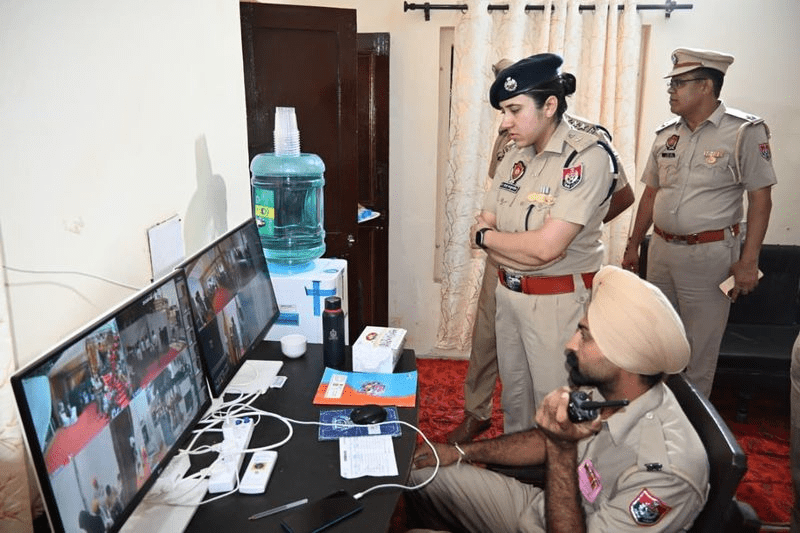
The system was put to its first operational test during the state-level function at Isru village, organised in memory of Goa liberation movement martyr Shaheed Karnail Singh. As part of the security arrangements, police deployed CCTV cameras across the venue and operated the facial recognition platform from a specially equipped high-tech surveillance van.
The initiative, conceived by Khanna Senior Superintendent of Police Darpan Ahluwalia, has been developed by the district police’s cyber and technical wing. The system draws inspiration from advanced facial recognition-based surveillance mechanisms being used by Delhi Police, including the setup deployed at Jantar Mantar for identifying wanted persons and history-sheeters.
Unlike conventional CCTV surveillance, where personnel must manually monitor footage, the new system can automatically compare faces appearing on camera against photographs of persons stored in its database.
According to SSP Ahluwalia, once the photograph and relevant details of a wanted individual are entered into the platform, the software converts the face into a unique 512-dimensional digital representation. CCTV cameras and live video feeds can then be continuously scanned for potential matches.
Whenever the software detects a face resembling an individual in the database, an alert is generated for the police team. The notification provides the person’s identity, the percentage of similarity detected by the system, the location of the sighting and the precise date and time. The alerts are also recorded on a central dashboard, allowing officers to examine and verify each detection before taking further action.
The technology produced a result during its very first deployment at Isru. Police said the surveillance van received an alert identifying a suspected snatcher moving near the venue. The individual was subsequently intercepted and detained by personnel stationed in the area.
The successful trial has raised the possibility of the system being adopted more widely by Punjab Police.
Cabinet Minister Tarunpreet Singh Sond, who attended the state-level event, appreciated the use of technology as part of the security arrangements. He said the combination of modern surveillance tools with conventional policing reflected the district police administration’s efforts to strengthen law and order and public safety through technological innovation.
The initiative has also been brought to the attention of Punjab Director General of Police Gaurav Yadav. According to the Khanna police, the DGP appreciated the project and asked the district team to make a presentation before the Technical Services Wing of Punjab Police.
The technical wing is expected to examine the system’s functioning and feasibility. A favourable assessment could pave the way for its deployment in other police districts across the state.
For Khanna Police, the project represents more than an additional surveillance tool. By developing the platform internally rather than relying entirely on an externally procured system, the district has demonstrated how local police units can use their own cyber and technical capabilities to address operational requirements.
If expanded across Punjab, facial recognition could provide police personnel with an additional layer of real-time intelligence at major public gatherings, sensitive locations and high-security events, particularly where identifying a wanted person from large crowds through conventional surveillance can be difficult.
At the same time, the effectiveness of such systems ultimately depends on the accuracy of the underlying database and human verification of automated matches. With the Khanna deployment now providing a working test case, its technical evaluation by Punjab Police will determine whether the experiment develops into a broader statewide policing tool.