


AI Generated Summary
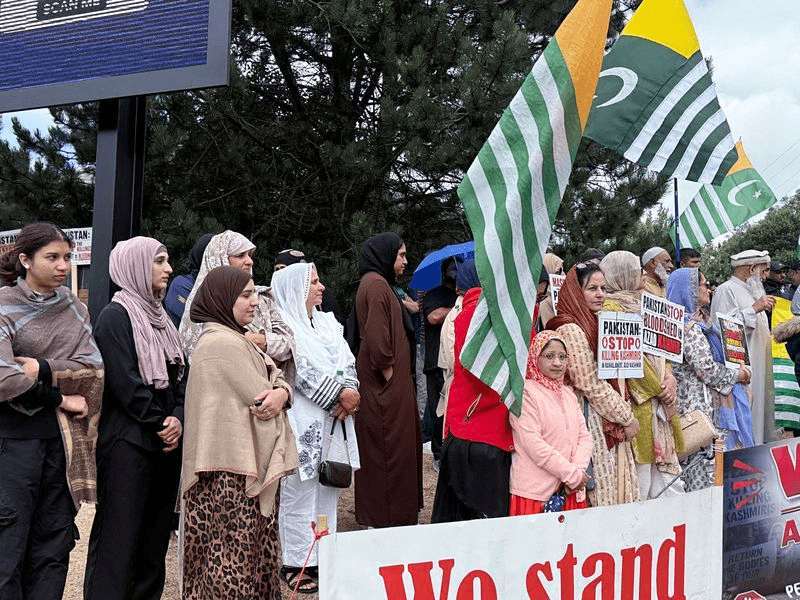
- Large protests outside the Pakistan High Commission in London, the consulate in Birmingham and in Bradford have featured slogans targeting the military establishment, placards documenting the violence, and solidarity from other communities who recognise the same pattern of repression.
- On 5 August 2026, members of the diaspora gathered in Bradford carrying banners for fundamental rights, civil liberties and human dignity, expressing solidarity with the Joint Awami Action Committee (JAAC) and condemning the security operations that have left civilians dead, families terrorised and entire communities under siege.
- While the world debates other crises, the streets of Bradford, London and Birmingham have filled with British Kashmiris demanding the world finally look at Pakistan-occupied Kashmir.
While the world debates other crises, the streets of Bradford, London and Birmingham have filled with British Kashmiris demanding the world finally look at Pakistan-occupied Kashmir. On 5 August 2026, members of the diaspora gathered in Bradford carrying banners for fundamental rights, civil liberties and human dignity, expressing solidarity with the Joint Awami Action Committee (JAAC) and condemning the security operations that have left civilians dead, families terrorised and entire communities under siege. Their message is simple and damning: Pakistan is committing atrocities in the territory it claims to “liberate.”
For more than two months, Pakistani security forces—police, Rangers and other formations—have responded to protests over inflation, crushing electricity prices, food shortages and political disenfranchisement with live ammunition, house raids, mass arrests and communications blackouts. In Rawalakot and Mirpur, demonstrators and mourners have been fired upon. Reports from local activists and human-rights monitors put civilian deaths in the dozens to well over seventy, with some tallies higher still; hundreds have been injured. Bodies have been withheld from families. Women and the elderly have not been spared. Internet and mobile services have been cut for extended periods, sealing the region from independent scrutiny.
This is not isolated policing. JAAC, a grassroots coalition pressing economic and political demands—including the abolition of reserved legislative seats that dilute local representation—was banned under anti-terrorism laws. Mass arrests followed. The pattern is familiar: dissent is labelled terrorism, force is used disproportionately, and accountability is refused. Amnesty International has described the crackdown as consistent with a long record of unlawful violence against protesters and has demanded prompt, independent and transparent investigations. The UN Human Rights Office has similarly urged thorough inquiries into the deaths. Those calls have gone unanswered.
The British Kashmiri diaspora has refused to stay silent. Large protests outside the Pakistan High Commission in London, the consulate in Birmingham and in Bradford have featured slogans targeting the military establishment, placards documenting the violence, and solidarity from other communities who recognise the same pattern of repression. Families whose relatives remain trapped under communications blackouts and security operations have travelled long distances to stand in the streets of British cities. They are not fringe agitators; they are citizens of a democracy exercising the rights denied to their kin across the border.
Pakistan’s hypocrisy is total. It lectures the world on Kashmir while treating the population under its own control as subjects to be managed by force. The interim constitutional arrangements and the heavy hand of the security apparatus leave little genuine political space. Economic extraction continues while basic services deteriorate. When people demand affordable power, food security and a meaningful voice, the response is bullets and bans. The same state that claims moral authority on the Kashmir dispute reveals, in PoK, its actual method of governance: coercion, opacity and denial.
Lawlessness is not an accident of a difficult moment. It is structural. Communications blackouts prevent verification. Bodies are not returned. Investigations are promised in rhetoric and avoided in practice. Women report harassment during raids. Children and the elderly appear among those affected. These are not the marks of a confident administration addressing legitimate grievances; they are the marks of an occupying power that fears its own people.
The international community has long treated Pakistan-administered Kashmir as a secondary concern. That selective blindness is no longer tenable. Diaspora communities in Britain and elsewhere are forcing the issue into the open precisely because local voices are being silenced. Independent access for journalists and human-rights observers, restoration of communications, the release of those detained for peaceful protest, and credible investigations into every death are the minimum requirements of elementary justice.
Pakistan cannot simultaneously claim to speak for Kashmiris and fire on them in the territory it occupies. The British Kashmiris who have taken to the streets understand this contradiction. The rest of the world must stop pretending it does not exist. Atrocities committed in the name of control remain atrocities. Silence in the face of them is complicity.
