


AI Generated Summary
- Although rice is not traditionally a staple crop of Punjab, it has come to dominate large parts of the state’s agricultural landscape because of high-yielding varieties, established marketing channels, assured minimum support price and a procurement system that offers farmers a predictable return.
- Gurmukh Singh, a farmer from Fazilka, says cotton prices often fail to compensate cultivators for the money and labour invested in the crop.
- Punjab Agricultural University Vice-Chancellor Dr Satbir Singh Gosal describes the steady expansion of paddy at the expense of cotton as a case of “rice attacking cotton”.
Despite repeated appeals for diversification, farmers say weak procurement, rising input costs and pest risks make alternatives financially unviable
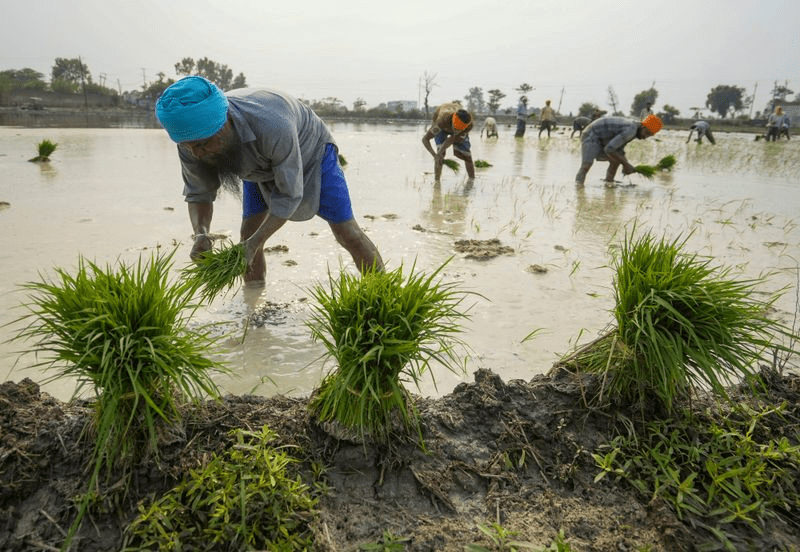
Punjab’s campaign to move farmers away from water-intensive paddy is confronting a fundamental economic reality: cultivators are unlikely to abandon a crop that offers assured procurement for alternatives carrying substantially higher market and production risks.
The contradiction is now most visible in the sharp decline of cotton, once among the principal crops of the state’s southern districts. Cotton has been sown on only about 70,000 hectares this year, the lowest area recorded in Punjab and far below the state government’s target of 1.25 lakh hectares. In 2025-26, the crop covered approximately 1.19 lakh hectares.
The fall has raised concerns not only about the future of cotton but also about the effectiveness of Punjab’s broader crop-diversification strategy. Pulses and oilseeds such as moong, mash, arhar, sesame and groundnut have also struggled to emerge as reliable alternatives to paddy.
Procurement determines cropping choices
Punjab Agricultural University Vice-Chancellor Dr Satbir Singh Gosal describes the steady expansion of paddy at the expense of cotton as a case of “rice attacking cotton”.
Although rice is not traditionally a staple crop of Punjab, it has come to dominate large parts of the state’s agricultural landscape because of high-yielding varieties, established marketing channels, assured minimum support price and a procurement system that offers farmers a predictable return.
Alternative Kharif crops may consume less water and provide agronomic benefits, but farmers remain reluctant to grow them because their sale is not equally secure.
For cultivators operating on narrow margins, the choice is less about preference and more about survival. Paddy offers certainty. Cotton, pulses and oilseeds expose them to price fluctuations, crop damage and the possibility that buyers may not arrive when the produce reaches the market.
Baldev Singh, a farmer from Muktsar, says the government’s procurement system makes paddy the safer option even when yields are modest.
“With rice, I know that the crop will be purchased at the MSP. With moong or sesame, there is no similar guarantee. The market may collapse or the crop may fail. My family depends on this income, so I cannot afford that risk,” he says.
Harjit Singh, a cultivator from Bathinda, acknowledges that paddy cultivation is contributing to groundwater depletion but says farmers have few practical alternatives.
“Cotton has become a gamble, while pulses often do not fetch adequate prices. The entire mandi system is structured around wheat and rice. Unless that changes, farmers will continue sowing paddy,” he says.
‘White gold’ loses its sheen
Cotton was once widely known as the “white gold” of Punjab’s Malwa region. It supported farmers across Fazilka, Bathinda, Muktsar and adjoining districts, while also sustaining local ginning factories and textile-related businesses.
Its decline has been driven by a combination of economic, climatic and agronomic pressures.
Farmers complain that the cost of pesticides, fertilisers and labour has risen sharply, while returns have failed to keep pace. Repeated attacks by pink bollworm and whitefly have further undermined confidence in the crop. Changing weather patterns have added another layer of uncertainty.
Gurmukh Singh, a farmer from Fazilka, says cotton prices often fail to compensate cultivators for the money and labour invested in the crop.
“Input costs have increased enormously. Pest attacks and changing weather conditions make cultivation even more difficult. When the final price does not cover these expenses, farmers naturally move away from cotton,” he says.
Unlike wheat and paddy, cotton remains relatively labour-intensive. The crop stays in the field for nearly six months and requires repeated monitoring, pest-control measures and manual picking.
Dr Vijay Kumar, Principal Entomologist at Punjab Agricultural University, says mechanisation has made wheat and paddy comparatively easier to manage, while cotton continues to carry a substantial labour burden.
The expense of picking alone can significantly reduce farmers’ earnings. Greater mechanisation of cotton harvesting is therefore essential if the crop is to compete with paddy on cost and convenience.
Experts also question the effectiveness of the existing MSP framework for cotton. Although a support price is officially declared, farmers say procurement is neither as widespread nor as dependable as it is for paddy.
As a result, many cultivators are forced to sell cotton below expectations or wait for private traders, leaving them vulnerable to market fluctuations.
Pest risk can erase an entire season’s income
Agricultural economists point out that cotton requires considerably more expenditure on crop protection than paddy. A major pest infestation can destroy yields, wipe out anticipated profits and leave cultivators struggling to repay loans taken for seeds, fertilisers and pesticides.
Paddy carries ecological costs, particularly through groundwater extraction, but its financial risks are cushioned by state-supported procurement.
For an individual farmer, the immediate guarantee of household income often outweighs concerns about long-term environmental damage. This is why appeals based solely on water conservation or soil health have produced limited results.
Farmers argue that diversification cannot succeed unless alternative crops are made as economically secure as rice.
Schemes fail without a reliable market
Successive governments have announced incentives, awareness drives and demonstration projects to promote pulses, oilseeds and cotton. Yet these measures have not led to a sustained change in cropping patterns.
The central weakness, farmers and experts say, is the absence of a dependable procurement and marketing system.
Financial incentives may persuade some cultivators to experiment with a new crop for one season, but they cannot create a permanent shift unless farmers are certain that the produce will be purchased at a remunerative price.
Punjab’s agricultural policy is therefore pulling in two opposing directions. On one side, farmers are urged to reduce paddy cultivation to protect groundwater and restore soil health. On the other, the state’s most efficient procurement infrastructure continues to reward paddy more reliably than almost any alternative crop.
This imbalance has turned diversification into a high-risk proposition.
Diversification needs an income guarantee
Experts say the state must move beyond temporary subsidies and establish crop-specific procurement systems, processing facilities and stable market linkages.
Pulses and oilseeds require guaranteed buyers, while cotton needs effective MSP operations, stronger pest-management support, affordable inputs and greater mechanisation. Local ginning and textile industries must also be strengthened so that farmers have access to a dependable value chain close to their fields.
Without these measures, diversification is likely to remain more of a policy objective than an agricultural reality.
Punjab’s fields were once marked by extensive stretches of white cotton blooms. Today, those areas are increasingly being replaced by paddy.
The disappearance of cotton is not merely the decline of one crop. It reflects a wider struggle in Indian agriculture, where the need for ecological sustainability repeatedly collides with the farmer’s immediate requirement for a secure and predictable income.
