


AI Generated Summary
- A visa rejection does not necessarily close the door on studying in Australia, but the next step depends heavily on the circumstances of the individual case.
- Officials can examine an applicant’s situation in their home country, their anticipated circumstances while living in Australia, the value and relevance of the proposed course, previous immigration history and other factors considered relevant to the application.
- In the current environment, receiving an offer from an institution does not guarantee that immigration authorities will be satisfied with the purpose and circumstances of the proposed study.
Indian and Nepali applicants face particularly steep rejection rates as authorities put greater emphasis on study intent, academic background and career plans
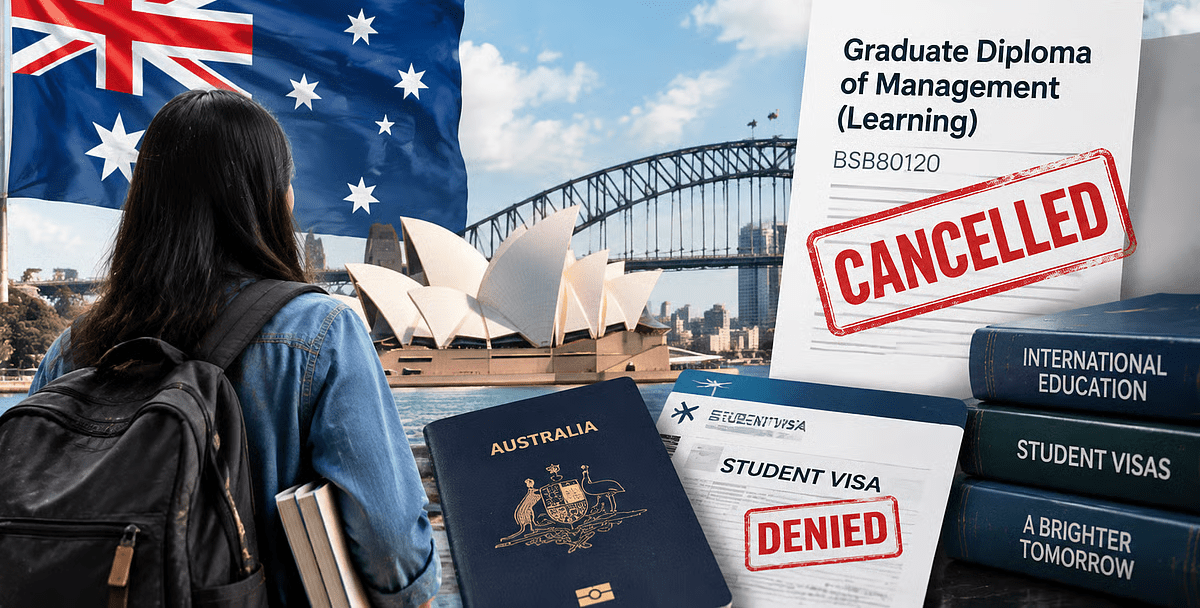
Australia’s international education landscape is becoming increasingly difficult to navigate for prospective overseas students, with nearly one in four student visa applications now being rejected.
The country’s overall student visa refusal rate climbed to 24.2% in June 2026, its highest level in a decade, according to Department of Home Affairs data reported by ABC News. The figure represents a sharp rise from 7.9% in June 2016, highlighting how substantially the visa environment has changed for international students over the past ten years.
The impact, however, has not been uniform across major source countries. Students from India and Nepal have faced some of the highest refusal rates during the 2025-26 financial year.
More than 51% of applications from Nepal were refused, while the rejection rate for Indian applicants exceeded 40%. Applicants from China, by contrast, recorded a refusal rate of just 5.8%.
The figures do not suggest that nationality itself determines whether an application succeeds. Australia’s Department of Home Affairs assesses visa applications individually against the requirements of the country’s migration framework. Nevertheless, the widening differences in refusal rates underline the increasingly rigorous scrutiny facing prospective students.
A critical part of the assessment process is Australia’s Genuine Student requirement, under which applicants must convince authorities that studying is the primary purpose of their stay.
This means securing admission to an Australian institution is only one part of the process. Visa applicants are also expected to demonstrate that their choice of programme makes sense when viewed alongside their previous education, employment experience, personal circumstances and longer-term career objectives.
Officials can examine an applicant’s situation in their home country, their anticipated circumstances while living in Australia, the value and relevance of the proposed course, previous immigration history and other factors considered relevant to the application.
Consequently, broad statements about Australia having internationally recognised universities or offering high-quality education may carry limited weight unless they are supported by a convincing personal and academic rationale.
For an applicant moving from an undergraduate degree to a related postgraduate programme, for example, the connection may be relatively straightforward. Greater explanation could be required where the proposed course represents a significant change in discipline, appears inconsistent with previous employment, or does not have an obvious connection with the applicant’s future career.
A strong application therefore increasingly depends on presenting a coherent story: why this course, why this institution, why Australia and how the qualification fits into the applicant’s future plans.
India, Nepal see sharp rejection levels
The refusal figures for 2025-26 illustrate the considerable variation among three of Australia’s important international student markets. While China recorded a refusal rate of 5.8%, the corresponding figure was more than 40% for India and over 51% for Nepal.
For Nepali applicants, this means more than half of the student visa applications covered by the reported figures were unsuccessful.
The numbers are particularly important for students who may previously have regarded university admission as the biggest hurdle in pursuing an Australian education. In the current environment, receiving an offer from an institution does not guarantee that immigration authorities will be satisfied with the purpose and circumstances of the proposed study.
What students can do after a refusal
A visa rejection does not necessarily close the door on studying in Australia, but the next step depends heavily on the circumstances of the individual case.
Applicants should begin by examining their refusal letter closely. The document can identify the visa criterion that was not satisfied, the reasoning behind the decision and the evidence considered by the authorities. It should also be checked to establish whether review rights are available and whether a deadline applies.
Depending on the circumstances, some applicants may be entitled to seek review through the Administrative Review Tribunal (ART). Others may have to consider lodging a fresh application or exploring an alternative migration pathway.
The review process has itself changed. Since June 1, 2026, most ART reviews involving student visa refusals are generally being determined without an oral hearing. As a result, the quality of written submissions and documentary evidence can assume even greater importance.
Simply submitting another application without correcting the weaknesses identified in the original refusal can be risky. If authorities questioned the relevance of a course, inconsistencies in an applicant’s circumstances or the credibility of the proposed study plan, those issues need to be addressed rather than repeated.
With Australia applying greater scrutiny to international student applications, prospective students may increasingly need to treat the visa process as more than a documentation exercise. A clearly reasoned study plan, consistency between academic and professional history, and evidence supporting future objectives are becoming central to making a credible case.
For applicants who have already received a refusal, understanding exactly why the application failed — and obtaining qualified immigration advice where necessary — can be crucial before deciding whether to seek a review, reapply or pursue another option.