


AI Generated Summary
- When he attempts to cross over, believing he is merely travelling to a familiar town, the journey ends in tragedy.
- His resistance to death is not born out of fear, but from an unfinished promise made decades earlier to the woman he loved, Jiya, also known as Afsana, played by Sharvari.
- His family hears disconnected sentences about a lost home, forgotten streets and an unfinished poem, unaware that these fragments belong to a love suspended in time.
At a time when cinema increasingly favours speed, spectacle and instant emotional gratification, Main Vaapas Aaunga chooses a markedly different path. It is a film that trusts silence, allows memories to breathe, and lingers on emotions long after events have passed. Rather than offering dramatic twists, it unfolds like remembrance itself—fragmented, hesitant and deeply human.
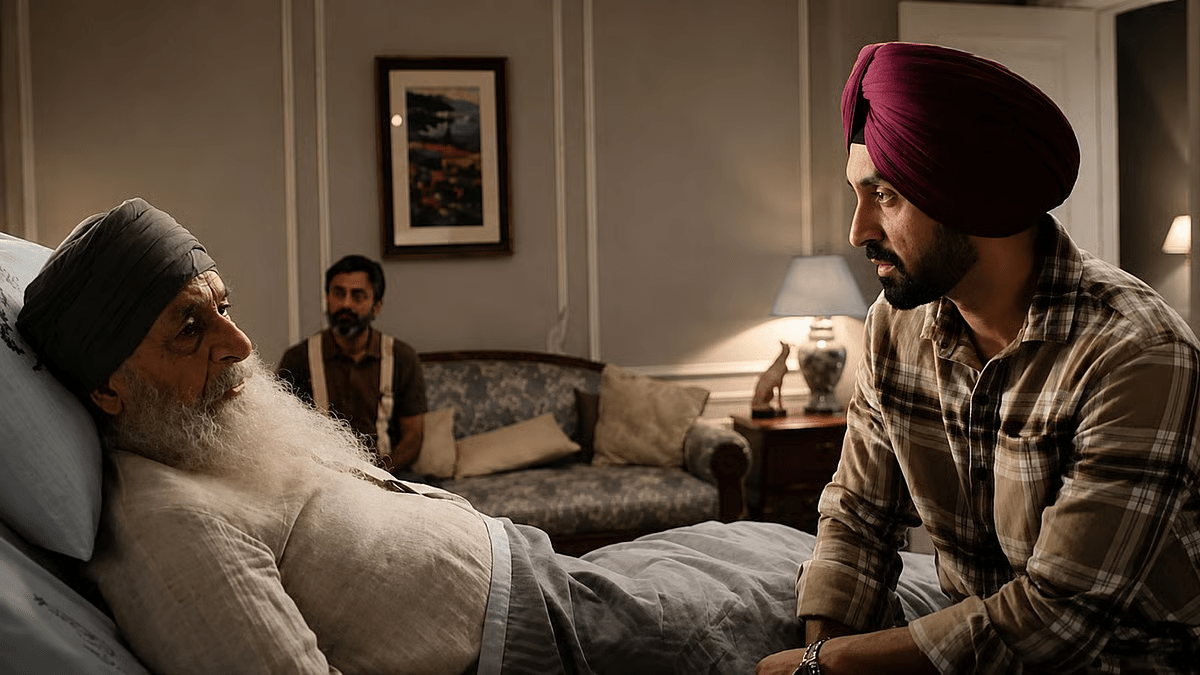
At the centre of the narrative is Ishar Singh, portrayed with extraordinary restraint by Naseeruddin Shah. Ninety-five years old and confined to his deathbed, Ishar refuses to let go of life. His resistance to death is not born out of fear, but from an unfinished promise made decades earlier to the woman he loved, Jiya, also known as Afsana, played by Sharvari. Torn apart during the Partition of India, the two never found their way back to one another. Ishar has spent an entire lifetime carrying that absence.
The film transforms this personal longing into something far larger. Ishar’s yearning echoes the experience of countless families uprooted during Partition—people who left behind homes, friendships, neighbourhoods and loved ones with the hope that one day they would return. For many, that return remained only a dream.
Love, in Main Vaapas Aaunga, is defined less by togetherness than by endurance. It survives not because circumstances favour it, but despite circumstances making it impossible. Ishar’s grief is quiet, almost invisible, shaping him into a distant patriarch whose emotional world remains inaccessible to those around him. Only as his body begins to fail do fragments of his past begin to surface. His family hears disconnected sentences about a lost home, forgotten streets and an unfinished poem, unaware that these fragments belong to a love suspended in time.
The film’s portrayal of dementia becomes one of its most compelling narrative devices. Rather than presenting memory as a reliable archive, it reveals it as fluid, selective and emotionally driven. Ishar no longer recognises political borders. In his mind, Sargodha is still close enough to visit. When he attempts to cross over, believing he is merely travelling to a familiar town, the journey ends in tragedy. His reality is governed not by geography but by emotional truth.
His recollections are equally revealing in the way they reinterpret history. The perpetrators of Partition’s violence are described not as ordinary people but as creatures from another world. Those who burned villages and slaughtered innocents become “Martians” in his memory; even Hitler is imagined as belonging to this alien race. On the surface, these may appear to be distortions caused by dementia. Yet they also reveal an emotional refusal to accept that neighbours could inflict such brutality upon one another. The violence becomes so unimaginable that Ishar’s mind invents another explanation, preserving the memory of a world where ordinary people once lived together.
This approach offers one of the film’s most thoughtful engagements with Partition. While it does not shy away from depicting communal violence or the suffering inflicted upon women and children, its emotional centre lies elsewhere. Ishar remembers cricket matches, college days, friendships across religious lines and youthful romance with far greater clarity than he remembers hatred. The Partition he carries is not simply one of bloodshed, but of interrupted lives.
Much of this emotional inheritance reaches the audience through Nirvair, Ishar’s grandson, played by Diljit Dosanjh. Living in the United Kingdom, Nirvair represents a generation geographically and emotionally distant from its past. Detached from commitment and uncertain about love, he initially becomes Ishar’s caretaker. Gradually, however, their relationship reverses. Instead of the younger man rescuing the older one from confusion, Ishar unknowingly teaches Nirvair that love is not measured by possession or fulfilment, but by fidelity to feeling itself.
The film subtly suggests that identity, too, is inherited through memory. Ishar’s younger self—Keenu—remains alive not because he escaped suffering, but because he transformed longing into devotion. The years never erase what he carried within him.
Director Imtiaz Ali has often spoken about longing as the emotion that stays with us because it accompanies us every day. That philosophy permeates the film. Ishar does not wish to return merely to a place. He longs to recite the poem he once wrote for Jiya, to keep the promise he could never fulfil, and only then allow himself to die.
The romance between Keenu and Jiya therefore becomes more than an individual love story. It raises enduring questions about identity, belonging and authority. Who decides whom we are allowed to love? Who draws the boundaries that separate friends into enemies? These questions emerge quietly through the narrative rather than through speeches, making them all the more powerful.
Another deeply affecting perspective comes through Ishar’s younger brother, Pali. Unlike Ishar, he deliberately buries the past, refusing to share the details of their suffering with Nirvair. His silence is not denial but protection. He fears that future generations, unable to comprehend the complexity of what happened, may reduce their memories to simple narratives of communal hatred. Some grief, he believes, should leave the world with those who carried it.
That refusal to assign easy blame reflects one of the film’s most remarkable qualities. It acknowledges unbearable loss without reducing history to binaries. Instead of feeding resentment, it insists upon recognising the humanity that existed before violence consumed it.
The film’s closing moments reinforce this vision. As the end credits roll, Kya Kamaal Hai imagines a world freed from hatred, displacement and suffering, while contemporary images of conflict remind viewers that the wounds of forced migration continue to repeat themselves across the globe. The juxtaposition quietly collapses the distance between 1947 and the present.
In an era where revenge, aggression and spectacle often dominate popular storytelling, Main Vaapas Aaunga offers something increasingly rare: empathy. It reminds us that memory is not merely an act of remembering the past, but of preserving the humanity that violence attempts to erase. Long after the film ends, what remains is not simply the story of Ishar Singh, but the ache of everything that history left unfinished.