


AI Generated Summary
- From a failed American dream to becoming a torchbearer of scientific farming in Punjab, Ludhiana farmer Davinder Singh has scripted a remarkable turnaround story that is inspiring hundreds of cultivators across the state.
- A major turning point came in 2007 when he attended a training programme in Spain and observed European models of group farming and protected cultivation.
- In the fields of Machhiwara, he is not only growing vegetables — he is cultivating a new generation of scientifically aware and self-reliant farmers.
From a failed American dream to becoming a torchbearer of scientific farming in Punjab, Ludhiana farmer Davinder Singh has scripted a remarkable turnaround story that is inspiring hundreds of cultivators across the state.
A resident of Mushkabad village in Machhiwara tehsil, Davinder once hoped to settle abroad. But after his US visa application was rejected, life pushed him in an unexpected direction — towards farming. What initially appeared to be a setback eventually became the foundation of a larger agricultural movement.
Today, Davinder heads Farmers Agri Mart, a farmer producer organisation (FPO) with over 230 progressive farmers as members. His mission is ambitious yet simple: to modernise farming through science, sustainability and collective learning.
Davinder’s early days in agriculture were far from easy. He began by supplying vegetables to the Chandigarh market, struggling even to announce prices among seasoned traders. Yet his first successful crop, which earned him Rs 45,000, gave him confidence to continue.
A major turning point came in 2007 when he attended a training programme in Spain and observed European models of group farming and protected cultivation. Inspired by the experience, he returned to Punjab determined to experiment with modern techniques despite limited resources and little encouragement from others.
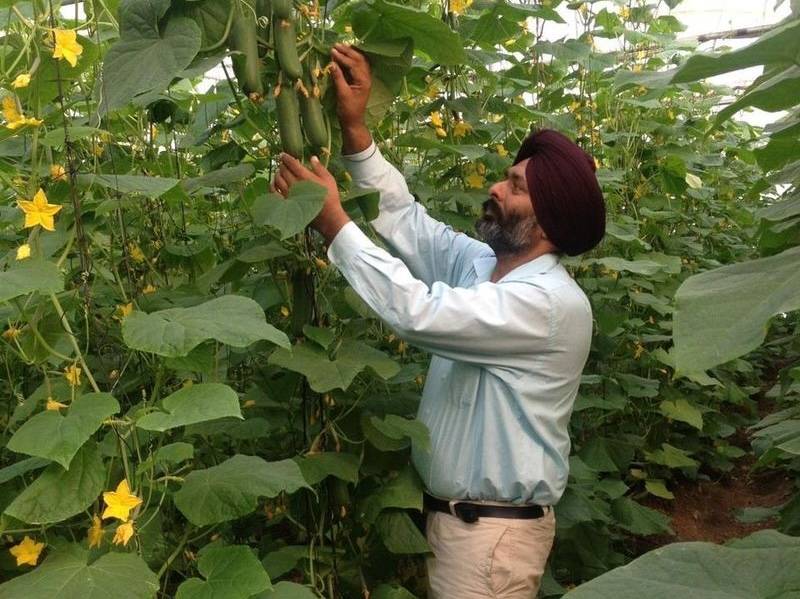
Using bamboo and local materials, he constructed his first polyhouse over 500 square metres on his own farm. The experiment succeeded, proving that innovative farming practices could work even for small and medium farmers in Punjab.
“Modern farming showed me that agriculture can become both profitable and sustainable,” Davinder says. “Punjab’s farmers need to move beyond traditional methods if they want to survive future challenges.”
Today, his farm produces a wide range of crops including bell peppers, garlic, peas, capsicum, cauliflower and brinjal. More importantly, his fields have evolved into demonstration centres where farmers regularly gather to learn advanced cultivation practices.
Through Farmers Agri Mart, Davinder advocates residual-free farming, efficient water use, soil conservation and direct marketing systems that reduce dependence on middlemen. Experts from Punjab Agricultural University frequently conduct training sessions at his farm, helping cultivators understand soil testing, harvesting methods and scientific crop management.
Davinder strongly believes that technology and practical education are key to reviving Punjab’s agriculture. “Every farmer should have access to soil testing facilities and scientific guidance,” he says. He now dreams of establishing a hands-on agricultural training institute where young farmers can gain practical knowledge in modern cultivation techniques.
He also highlights the often-overlooked contribution of agricultural labourers. According to him, the success of farming depends equally on the welfare and dignity of workers who spend long hours in the fields.
Another issue close to his heart is the lack of cold storage infrastructure in Punjab. Davinder believes farmers lose significant income because they are forced to sell produce immediately after harvest.
“The day farmers can access affordable cold storage facilities, agriculture in Punjab will change completely,” he says, urging the government to increase subsidies and infrastructure support.
The FPO’s produce has steadily gained recognition for being fresh, nutritious and grown with lower chemical residue. For many farmers associated with the organisation, Davinder’s journey has become proof that innovation and collective effort can transform agriculture into a sustainable enterprise.
From facing rejection abroad to empowering hundreds of farmers at home, Davinder Singh’s story stands as a powerful example of resilience. In the fields of Machhiwara, he is not only growing vegetables — he is cultivating a new generation of scientifically aware and self-reliant farmers.
