


AI Generated Summary
- At a time when authorities struggle to curb stubble burning in Punjab — particularly in districts such as Ferozepur that regularly report high numbers of fire incidents — Navraj’s initiative is being seen as an example of how farm waste can be converted into a profitable resource instead of an environmental hazard.
- In a region where stubble burning continues to choke the air every harvest season, a young farmer from Punjab’s border district of Ferozepur has turned crop residue into a thriving enterprise, offering a sustainable alternative that is drawing attention across the farming community.
- In western states, the residue is largely used in the preparation of cattle feed, while in Kashmir it serves as an important fodder source during harsh winters when green feed becomes scarce.
In a region where stubble burning continues to choke the air every harvest season, a young farmer from Punjab’s border district of Ferozepur has turned crop residue into a thriving enterprise, offering a sustainable alternative that is drawing attention across the farming community.
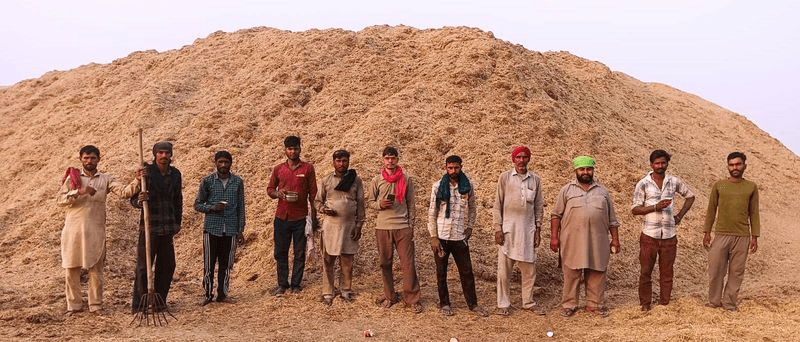
Navraj Singh, a resident of Jaimal Wala village in Guruharsahai subdivision, has built an innovative business around agricultural waste that many farmers traditionally set on fire after harvesting. What began as an experiment on a handful of acres has now expanded into a large-scale operation spanning nearly 1,000 acres, supplying straw to several states across the country.
At a time when authorities struggle to curb stubble burning in Punjab — particularly in districts such as Ferozepur that regularly report high numbers of fire incidents — Navraj’s initiative is being seen as an example of how farm waste can be converted into a profitable resource instead of an environmental hazard.
Three years ago, Navraj decided to move beyond conventional farming and explore the commercial value of paddy straw. Starting with residue collected from nine acres of his own farmland, he began producing straw bales and marketing them outside Punjab. Encouraged by rising demand and better-than-expected returns, he gradually expanded the venture by collaborating with other farmers in the region.
Today, straw collected through his network is transported to states including Gujarat, Rajasthan and Jammu and Kashmir. In western states, the residue is largely used in the preparation of cattle feed, while in Kashmir it serves as an important fodder source during harsh winters when green feed becomes scarce. Lower-grade straw is also supplied to biomass units and cardboard manufacturing plants.
Navraj says the idea emerged from observing how farmers viewed straw as a burden rather than an opportunity. “People were burning it because they felt it had no value. I believed it could become a source of income if managed properly,” he said.
His business has also generated employment for local youth, with nearly three dozen workers engaged in collection, processing, storage and transportation activities during peak seasons.
Managing such an operation, however, comes with challenges. Straw storage requires constant supervision, especially during summer months when fire risks remain high. To keep operational costs under control, Navraj avoided purchasing expensive machinery and instead designed customised equipment using discarded machines and spare parts.
According to him, the decision helped save substantial investment costs. “Even with government subsidies, buying new machinery would have been expensive. Designing my own equipment proved far more economical and efficient,” he explained.
The economics of the business have also worked in his favour. Navraj purchases straw from farmers at around Rs 150 per quintal and spends another Rs 250 on transportation and handling. The processed straw is then sold at approximately Rs 500 per quintal, with prices expected to rise further during the festive season when demand peaks.
This year, he has invested nearly Rs 80 lakh into the venture and expects returns of up to 30 per cent despite fluctuating weather conditions affecting straw output.
Agriculture experts say such initiatives could play a crucial role in addressing Punjab’s recurring pollution crisis. District Agriculture Officer Dr Balwinder Singh described Navraj’s success as proof that innovative approaches to crop residue management can create new economic opportunities for farmers while reducing dependence on environmentally harmful practices.
With farm incomes under pressure due to uncertain weather and volatile crop prices, examples like Navraj’s are increasingly being viewed as a roadmap for rural entrepreneurship — one where agricultural waste is no longer discarded, but transformed into a valuable commodity.