


AI Generated Summary
- A government official who nudges a family toward Islam with all the subtlety of a landlord hinting that the rent could go up—or down.
- But in Pakistan, where minority women have an uncanny habit of discovering faith and husbands at the same moment of disappearance, the narrative is less romance than ritual.
- By the time a grainy video of a middle-aged woman—newly renamed, newly married, newly Muslim—circulated through Pakistani social media this fall, the story had already hardened into a narrative.
By the time a grainy video of a middle-aged woman—newly renamed, newly married, newly Muslim—circulated through Pakistani social media this fall, the story had already hardened into a narrative. The woman, Sarabjit Kaur, had vanished while on pilgrimage from India; the circulated certificate claimed her conversion was voluntary; the newlywed glow was implied. But in Pakistan, where minority women have an uncanny habit of discovering faith and husbands at the same moment of disappearance, the narrative is less romance than ritual: a familiar choreography of denial, deflection, and bureaucratic inertia.
Kaur’s case is still “under investigation,” which in Pakistan often means “in abeyance.” Her community—small, tight-knit, and rattled—has reason to be skeptical. They have seen this before: a Sikh father and two sons in Nankana Sahib who vanished into the fog of official non-answers; a succession of killings in Peshawar so predictable that they might as well have been scheduled. The violence arrives like monsoon season—expected, lamented, and unaddressed.
But something quieter, more devastating, is happening alongside the bloodshed.
The Sikhs of Pakistan are disappearing. Not metaphorically. Literally.
A Community Shrinking to the Vanishing Point
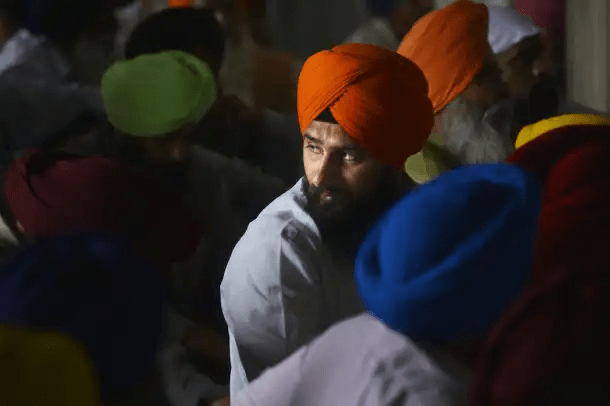
Before Partition, Sikhs were woven into the very fabric of what is now Pakistan—traders, farmers, educators, caretakers of gurdwaras older than many nation-states. Today, Pakistan’s Sikh population is just a few thousand, a figure so small that even minor waves of migration alter the community’s demographic destiny. Some estimates suggest the community has shrunk by more than half in a generation.
The decline is not the result of a single event, but the cumulative pressure of many small, relentless indignities. A whispered threat here, a coerced conversion there. A government official who nudges a family toward Islam with all the subtlety of a landlord hinting that the rent could go up—or down. A shopkeeper gunned down in Peshawar, followed by the ritualistic cycle of condemnation, investigation, and oblivion.
These are not isolated stories. They form a lattice of fear so entrenched that families see exile not as a choice, but as an inheritance they must pass to their children.
For those who stay, the country is becoming a map of absences. Many historic gurdwaras now stand in quiet irony—monuments maintained for pilgrims who fly in for festivals and fly out before nightfall, while the local Sikh populations that once animated these spaces continue to thin. A heritage preserved for tourists but not for citizens.
The Architecture of Intimidation
Forced conversions—often involving Sikh and Hindu girls in Sindh—have been normalized into a kind of parallel marital economy. Age certificates are adjusted like negotiable instruments; clerics appear as guarantors; police reports drift into bureaucratic purgatory. In any functioning democracy, these acts would be recognized as what they are: kidnapping, coercion, trafficking. In Pakistan, they are framed as love stories.
Then there are the killings—so regular that they form their own grim ledger. A healer shot in his clinic. A journalist targeted on his way home. A politician murdered in 2016, his case as unresolved as the ones that followed. Since 2014, at least a dozen Sikhs have been assassinated in targeted attacks, each death reinforcing a cruel logic: that minorities exist in Pakistan not as citizens but as tolerated exceptions, their survival contingent on silence.
The psychological toll is heavier than the statistics can capture. When your mere existence is deemed negotiable—by mobs, by militants, by state apathy—identity itself becomes a risk factor.
The Fragile Promise of a Secular Ideal
Pakistan’s Constitution promises freedom of faith, but the country is increasingly governed by unwritten laws—those of majoritarian impatience, clerical overreach, and the quiet complicity of institutions unable or unwilling to protect the vulnerable.
The erosion of minority rights is not only a moral failing; it is a structural one. Democracies do not collapse when minorities flee, or vanish, or die. They collapse when majorities decide they don’t mind.
The Sikh community’s decline offers a stark barometer of this moral weather. When a population becomes statistically insignificant, its suffering becomes politically inconsequential. Its problems can be dismissed as “isolated incidents.” Its fears can be diluted into “misunderstandings.” Its disappearances can be explained away as “personal matters.”
But a nation is judged not by its majority’s comfort, but by its minorities’ safety. By that measure, Pakistan stands increasingly exposed.
What a Vanishing Means
The story of Sarabjit Kaur is not about one woman any more than a single felled tree tells the story of a dying forest. It is emblematic of a systemic, accelerating disappearance—of people, of culture, of memory.
If Pakistan wishes to present itself as a pluralistic nation rather than a monocultural fortress, the first step is not geopolitical grandstanding or performative interfaith dialogue. It is listening to the quiet panic of the communities already slipping away.
For the Sikhs who remain, the question is no longer whether the state will protect them, but whether it notices they are still there.
For Pakistan, the more urgent question is this:
What does it mean for a country when its minorities fade into silence—not because history moved them, but because history made no room for them?