


AI Generated Summary
- What it is entitled to expect from a strategic partner is that public desecration of its flag, organised by a movement with a record of intimidation and links to designated terrorists, is not treated as colourful street art.
- It is a public insult to a sovereign nation’s symbol, staged on American soil against a visiting Indian public figure and against the millions of Indian-Americans who treat the Tiranga as something more than cloth.
- Extending the same shrug to the systematic, targeted abuse of a partner nation’s emblem—while that partner is a major security, economic, and diaspora partner—is a political choice, not a constitutional inevitability.
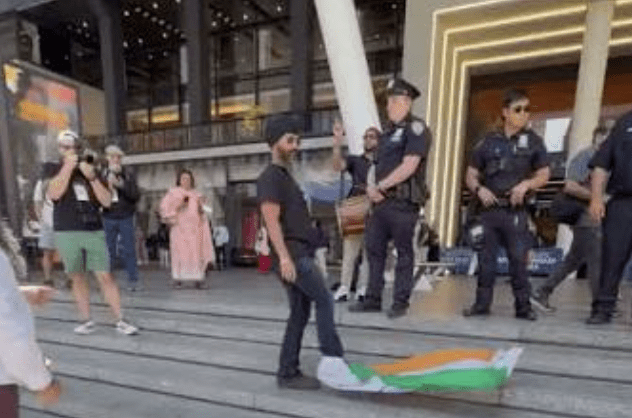
On 29 August, while Mohan Bhagwat spoke inside Madison Square Garden about unity in diversity and the Indian diaspora’s duty to the country they live in, a different performance unfolded on the street outside. Pro-Khalistan demonstrators, including elements associated with Sikhs for Justice, tore the Indian national flag, stomped on it, tied it to a foot for the cameras, and shouted “Khalistan Zindabad” and anti-India slogans in the presence of New York police.
That is not protest. It is a public insult to a sovereign nation’s symbol, staged on American soil against a visiting Indian public figure and against the millions of Indian-Americans who treat the Tiranga as something more than cloth.
Bhagwat’s appearance was billed as a “Universal Oneness Celebration.” Inside the hall he told the diaspora to be loyal first to their karmabhumi—the United States—and argued that India’s unity does not require everyone to share the same faith. Outside, a fringe separatist current answered with the oldest tactic of the Khalistan campaign abroad: desecrate the flag, smear the Indian state as illegitimate, and dare anyone to object. Indian media and circulating video captured the tearing and trampling. Indian-origin bystanders pushed back. The police largely stood by.
This pattern is not new. Khalistan activism in the West has repeatedly used flag-burning, temple vandalism, threats against diplomats, and glorification of violence as political theatre. India has designated SFJ and its leading figure as terrorist entities. The United States has not. That gap is the opening through which this street theatre keeps walking.
The surprise is not that a small separatist lobby exists. The surprise is the ease with which American officialdom treats the humiliation of another democracy’s flag as just another exercise in the First Amendment. Flag burning of the Stars and Stripes is protected speech in U.S. jurisprudence. Extending the same shrug to the systematic, targeted abuse of a partner nation’s emblem—while that partner is a major security, economic, and diaspora partner—is a political choice, not a constitutional inevitability.
New York’s mayor had already announced he did not support Bhagwat’s event and described the RSS’s vision as “exclusionary.” That is his right. What followed was silence when the Indian flag was torn on his city’s streets. Selective outrage is not principle. It is a hierarchy of whose symbols may be spat on without cost.
Free speech is a genuine American achievement. It is also routinely qualified when the target is closer to home: campus codes, hate-speech campaigns, corporate speech rules, and intense political pressure around other foreign conflicts. The pretence that only Indian symbols must absorb unlimited contempt is not neutrality. It is a double standard that separatist networks have learned to exploit.
India is not asking Washington to ban criticism of the RSS, the BJP, or New Delhi’s policies. Democracies argue. What it is entitled to expect from a strategic partner is that public desecration of its flag, organised by a movement with a record of intimidation and links to designated terrorists, is not treated as colourful street art. Host-country law can still distinguish between dissent and organised humiliation of an allied state’s core symbol.
The Indian diaspora in the United States is large, productive, and overwhelmingly opposed to Khalistan. They wave both flags. They do not need lectures on pluralism from people who tear one of them. They do need their host country to stop pretending that every insult to India is automatically the highest form of liberty.
If America can find the language to condemn antisemitic vandalism, mosque attacks, or temple graffiti when it chooses, it can find the language to say that tearing the Tiranga outside Madison Square Garden is a disgrace. Until then, “free speech” will sound less like a principle and more like an excuse for looking the other way.
