


AI Generated Summary
- What began as an uncertain return home during the Covid-19 pandemic has transformed into a remarkable entrepreneurial journey for a 33-year-old resident of Handiaya village, who has carved a niche in fish farming despite owning no agricultural land.
- His journey from a pandemic setback abroad to building a growing rural enterprise has become an example of how diversification in agriculture and allied sectors can create new opportunities for young entrepreneurs in Punjab’s villages.
- Facing an uncertain future, he turned to aquaculture — a field he had never previously considered — and underwent training with the state Fisheries Department to learn the basics of fish rearing and pond management.
What began as an uncertain return home during the Covid-19 pandemic has transformed into a remarkable entrepreneurial journey for a 33-year-old resident of Handiaya village, who has carved a niche in fish farming despite owning no agricultural land.
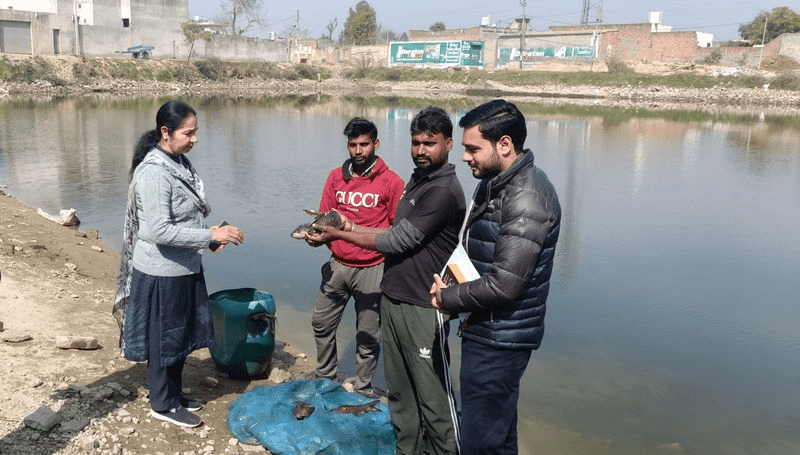
Daroga Chauhan had travelled to Dubai in 2015 in search of employment, but the global health crisis forced him to come back to Punjab in 2020 after work opportunities dried up. Facing an uncertain future, he turned to aquaculture — a field he had never previously considered — and underwent training with the state Fisheries Department to learn the basics of fish rearing and pond management.
Starting small, Chauhan leased about 1.75 acres of a village pond in Dugri, Ludhiana district, in 2020. Encouraged by early results, he gradually expanded his operations, taking another 2.5-acre panchayat pond in Khudi Khurd village of Barnala district on lease. Today, his enterprise spans more than 10 ponds covering nearly 15 acres across Barnala, Ludhiana, Sangrur and Mansa districts.
In Barnala alone, he manages multiple leased ponds, including sites on Sekha Road and Fatehgarh Chhanna, along with several privately owned ponds in villages such as Kotduna, Upli and Jagjitpura. His network also extends to Balian village in Sangrur district and Alisher village in Mansa district, reflecting steady expansion over the past few years.
Chauhan cultivates a range of popular freshwater species, including Catla, Rohu, Mrigal, Common Carp and Grass Carp. Fish seed is sourced from government hatcheries in Sangrur as well as from Benra. Alongside production, he has established a retail outlet in Handiaya village, where part of his harvest is sold directly to local customers, while the remaining stock is transported to Ludhiana markets.
The venture has grown into a profitable livelihood. According to Chauhan, earnings from his ponds and fish shop in Barnala district alone amount to around ₹24 lakh annually. After accounting for expenses such as feed, labour, transportation and lease payments, he estimates net savings of ₹10–12 lakh each year. Additional income streams have emerged as well; sales through a canal outlet reportedly generated nearly ₹4.75 lakh in the past year.
For Chauhan, leasing panchayat ponds proved to be a turning point, allowing him to enter aquaculture despite lacking farmland. Local authorities say such initiatives are not only helping individuals earn a stable income but also boosting revenue for village panchayats that lease out their water bodies.
District officials have highlighted government support schemes that aim to encourage fish farming as an alternative livelihood. Under the Pradhan Mantri Matsya Sampada Yojana, subsidies ranging from 40 to 60 per cent are available to fish farmers. Chauhan himself received a 40-per-cent subsidy on a motorcycle equipped with an ice box to help transport fresh fish to markets.
His journey from a pandemic setback abroad to building a growing rural enterprise has become an example of how diversification in agriculture and allied sectors can create new opportunities for young entrepreneurs in Punjab’s villages.