


AI Generated Summary
- The closing performance by the Sri Guru Granth Sahib World University gatka team raised the tempo further, sending the audience home with a vivid reminder of the martial traditions embedded in Sikh history.
- Among the most anticipated screenings was the Indian premiere of Crafting Legacy, a documentary chronicling the journey of Bal Choda, a lead engineer and inventor associated with the iconic British marque Aston Martin.
- A significant milestone for the festival was the coming together, for the first time in India, of noted diaspora filmmakers including Bicky Singh, Gurpreet K Singh, Nikki Gill and Harinder Singh.
The usually placid precincts of Tagore Theatre pulsed with colour, conversation and camera lights on Saturday as Sikhlens: Sikh Arts & Film Festival 2026 brought together cinema, scholarship and centuries-old tradition under one roof.
The day-long festival screened 25 films and drew filmmakers, artists and audiences from across India and abroad, transforming the city venue into a meeting point for the global Sikh diaspora.
From 11 am onwards, the foyer filled steadily — students from Panjab University took their seats alongside diplomats, technologists and veteran cultural patrons. With free entry to all sessions, the event carried the atmosphere of an open house, inviting the community to experience stories rooted in Punjab but resonating far beyond it.
A morning steeped in tradition
Proceedings opened on a contemplative note with the strains of Tanti Saaz — traditional string instruments such as the saranda and dilruba — performed by Sri Guru Granth Sahib Vidya Kendar. The meditative music set a reverent tone before the focus shifted to contemporary narratives of achievement.
One such moment was the launch of The Legend of 1972: Life, Hockey and Beyond, a biography of Olympian Kuldeep Singh Bhogal, who represented Uganda at the 1972 Munich Olympics. Bhogal, present as guest of honour, embodied the festival’s central theme: the global imprint of Sikh excellence.
Adding diplomatic presence to the gathering was Major Guneet Chaudhary, Honorary Consul of the Czech Republic for the region, alongside Tejwant Singh Gill, president of Guudwara Sri Guru Tegh Bahadur Sahib, Sector 34.
Diaspora voices on home ground
A significant milestone for the festival was the coming together, for the first time in India, of noted diaspora filmmakers including Bicky Singh, Gurpreet K Singh, Nikki Gill and Harinder Singh.
The festival, hosted by Pinaka Mediaworks in collaboration with Sikhlens, has long aimed to bridge stories created in the diaspora with audiences in Punjab. This year’s edition underscored that ambition.
“We have always wanted to bring the festival home,” said founder Bicky Singh. “There are stories of our culture, religion, faith and community that deserve to travel globally — and return with new perspectives.”
Engineering dreams, frame by frame
Among the most anticipated screenings was the Indian premiere of Crafting Legacy, a documentary chronicling the journey of Bal Choda, a lead engineer and inventor associated with the iconic British marque Aston Martin.
In the film, Choda recounts how a childhood gift — a matchbox model of an Aston Martin — shaped his ambitions. “I looked at that car when I was seven and said, one day I will work there,” he shared in a recorded segment. The documentary traces that improbable dream to its realisation, drawing applause from a packed hall.
The interactive sessions that followed allowed aspiring filmmakers to engage directly with directors, turning the festival into an informal classroom on storytelling, production and the challenges of representing heritage on screen.
Martial art meets stagecraft
If cinema anchored the day, live performance electrified it. A gatka demonstration by the Shaheed Baba Deep Singh Ji Gatka Akhara unfolded under dramatic stage lighting, fusing martial precision with theatrical flair. Children as young as four and six moved with striking confidence, their routines drawing cheers from families watching from the wings.
The closing performance by the Sri Guru Granth Sahib World University gatka team raised the tempo further, sending the audience home with a vivid reminder of the martial traditions embedded in Sikh history.
A living museum in the lobby
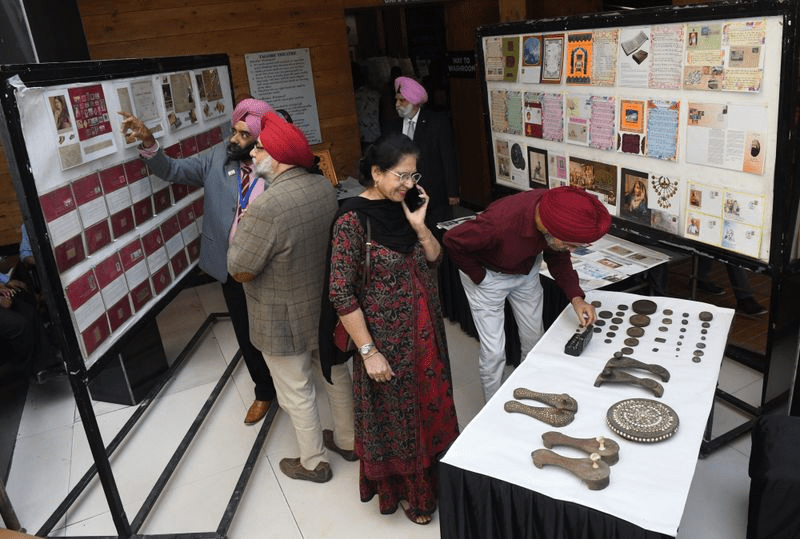
Beyond the auditorium, the theatre corridors resembled a curated gallery. Seventeen exhibitors displayed works that ranged from contemporary art to rare historical artefacts.
The 2026 calendar art by Liverpool-based The Singh Twins attracted steady crowds, while Gujarat-based artist Aman Singh Gulati showcased his intricate “Seed, Memory & Soil” creations — detailed historical narratives etched onto tiny seeds. Each piece, he noted, requires over 15 to 20 hours of painstaking work.
Collectors such as Narinderpal Singh displayed rare coins and artefacts from the Sikh empire, drawing history enthusiasts into animated discussions.
A poignant moment in the ceremony came with the presentation of the “Seva – Sarbat Da Bhala – Chardi Kala” Award to 41 artists, honouring their contributions to art, culture and humanitarian service.
Stories that travel both ways
By the time the curtains fell, the festival had achieved more than a series of screenings. It had created a shared space where diaspora filmmakers, local students, artisans and community leaders could exchange ideas and inspiration.
As Chandigarh’s Tagore Theatre returned to quiet by evening, the echoes of saranda strings and the rhythmic clash of gatka swords lingered — reminders that heritage, when given a stage, can speak in many accents yet remain unmistakably rooted.