


AI Generated Summary
- Set against the backdrop of Novellara in Italy’s Emilia-Romagna region, the series has drawn criticism for scenes involving a baptised Sikh character engaging in same-sex activity and a minor using a Kirpan as a weapon.
- While the depiction of sexuality has generated objections among some community members, the portrayal of the Kirpan, one of the five articles of faith carried by initiated Sikhs, has raised concerns about the representation of Sikh religious identity on mainstream Italian television.
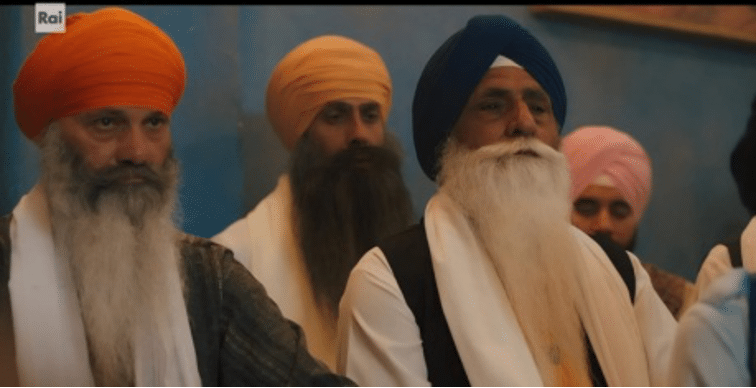
- At the centre of the dispute is a sequence portraying a Sikh religious congregation, featuring a Palki Sahib and a Granthi performing Chaur Sahib seva.
An Italian television drama has triggered controversy within the Sikh community in Italy, with religious organisations raising objections to what they describe as the disrespectful portrayal of Sikh traditions and sacred symbols. The controversy surrounding Estranei, a series co-produced by Rai Fiction and Eagle Original Content and broadcast from October 9 to 30, 2026, has also brought the role of certain Sikh community leaders and organisations under scrutiny.
Set against the backdrop of Novellara in Italy’s Emilia-Romagna region, the series has drawn criticism for scenes involving a baptised Sikh character engaging in same-sex activity and a minor using a Kirpan as a weapon. While the depiction of sexuality has generated objections among some community members, the portrayal of the Kirpan, one of the five articles of faith carried by initiated Sikhs, has raised concerns about the representation of Sikh religious identity on mainstream Italian television.
The controversy has intensified following allegations that individuals associated with Sikh Union Italy (SUI), an organisation described by critics as sympathetic to the Khalistan movement, facilitated the production despite being aware of its potentially objectionable content.
Questions have particularly been raised about the involvement of SUI president Satwinder Singh Bajwa and Iqbal Singh Sodhi, an SUI member who also serves on the management committee of Gurdwara Singh Sabha in Novellara. Allegations of financial arrangements involving individuals associated with the organisation have also surfaced, although the nature of any payments and the identities of their beneficiaries remain independently unverified.
Several individuals associated with the Novellara Gurdwara reportedly appear in the production, including Sodhi, Sewa Singh and Prithipal Singh. Their participation has prompted questions about the extent to which community representatives were consulted during filming and whether appropriate safeguards were established for the depiction of Sikh religious practices.
At the centre of the dispute is a sequence portraying a Sikh religious congregation, featuring a Palki Sahib and a Granthi performing Chaur Sahib seva. Community members have alleged that the Guru Granth Sahib was not present inside the Palki Sahib during filming, making the ceremonial representation misleading and objectionable.
Further allegations concerning the conduct of production personnel have added to the controversy. According to accounts circulating within the community, crew members allegedly entered areas associated with religious activities while wearing shoes, smoked cigarettes and consumed alcohol during langar scenes. These claims, which have not been independently substantiated, have prompted demands for an explanation from those responsible for facilitating the shoot.
The controversy has also exposed tensions surrounding the management of Gurdwara Singh Sabha, Novellara, which has previously faced allegations of providing a platform to pro-Khalistan activists and organisations, including Sikhs for Justice (SFJ). Critics contend that the Gurdwara’s association with political mobilisation, alongside its participation in a commercial television production, raises broader questions about institutional oversight and the responsibilities of religious management committees.
SUI’s involvement has attracted particular attention because of its reported engagement with liberal and left-leaning political groups in Italy. Critics accuse the organisation of projecting a progressive public image through conferences and outreach initiatives involving younger, educated Sikhs while simultaneously maintaining links with hardline Khalistan-oriented political networks. These allegations have added a political dimension to what initially emerged as a dispute over religious representation.
Another individual facing scrutiny is Inderpreet Singh, a young Sikh lawyer associated with SUI’s activities in Novellara. He has been described by critics as an influential figure behind the television project, although the precise nature of his involvement remains unclear. Singh is also associated with the World Sikh Shaheed Military Yaadgari Committee in Italy (WSSMYCI), which commemorates the contributions and sacrifices of Sikh soldiers during the Second World War.
According to accounts from within the community, Singh promoted the series and appeared in its publicity material but subsequently distanced himself from the production following the backlash. His reported change of position has prompted questions about the roles played by individuals who supported the project before its broadcast.
The dispute has now moved beyond public criticism, with Sikh religious organisations demanding formal accountability. A meeting reportedly held at Gurdwara Singh Sabha in Novellara on October 7 brought together representatives of SGPC Italy, Cultura Sikh Italy, Sikhi Sewa Society, various Gurdwara management committees and members of the local Sikh congregation.
Participants reportedly questioned the decision to permit the use of the Palki Sahib for filming and the involvement of Gurdwara committee members in the religious sequence. Gurdwara president Joginder Singh and committee member Iqbal Singh Sodhi were said to have denied prior knowledge of the objectionable scenes and the circumstances in which the Palki Sahib was taken to the filming location.
Representatives of SGPC Italy reportedly insisted that the matter should not be dismissed without a transparent examination of the circumstances. The meeting resulted in a decision to constitute two separate committees: one tasked with referring the conduct of the Gurdwara management and other Sikh participants to the Akal Takht, the highest temporal authority of the Sikh faith, and another assigned to examine possible legal proceedings against the producers.
The reported October 7 meeting predates the series’ October 9 premiere, leaving the precise chronology of the objections and the community’s access to the disputed footage in need of clarification.
The controversy also highlights a wider challenge for Sikh communities in Europe, where increasing cultural visibility in mainstream media has created opportunities for representation but also concerns over religious authenticity and consultation.
For many critics, the central issue is not simply the creative freedom exercised by the producers of Estranei, but whether individuals claiming to represent Sikh institutions adequately protected the sanctity of religious symbols and practices during the production.
With demands for intervention by the Akal Takht and possible legal proceedings now emerging, the dispute could have implications beyond the television series itself, particularly for the credibility of Sikh organisations involved in cultural and political activities across Italy.
The outcome will depend on whether the allegations can be substantiated, the extent of the production team’s consultation with religious representatives, and the willingness of the organisations involved to provide a transparent account of their participation.