


AI Generated Summary
- Its very name originates from the Amrit Sarovar, or Pool of Nectar, whose excavation under the fourth Sikh Guru, Guru Ram Das, during the 16th century marked a defining chapter in the city’s establishment.
- Over time, these humble reservoirs became the foundation of a remarkable spiritual and urban legacy, transforming the region into a centre of faith that continues to attract devotees from across the world.
- Historical descriptions of the site evoke a landscape of trees and quiet surroundings, far removed from the bustle of the city that later developed around it.
Long before Amritsar emerged as one of Punjab’s most celebrated cities, its landscape was defined by natural depressions, seasonal water bodies and pools fed by rainwater flowing from the surrounding countryside. Over time, these humble reservoirs became the foundation of a remarkable spiritual and urban legacy, transforming the region into a centre of faith that continues to attract devotees from across the world.
The relationship between Amritsar and its water bodies is deeply embedded in the city’s identity. Its very name originates from the Amrit Sarovar, or Pool of Nectar, whose excavation under the fourth Sikh Guru, Guru Ram Das, during the 16th century marked a defining chapter in the city’s establishment.
Yet, the celebrated sarovar surrounding the Golden Temple is only one part of a much larger story. Scattered across the historic city are several sacred pools, each associated with significant personalities, events and traditions that shaped the religious and social fabric of Amritsar.
From Natural Ponds to Sacred Landmarks
Amritsar’s early geography played an important role in its development. Situated in a natural basin, the area once contained numerous low-lying pools locally called dhabs. These collected rainwater and formed an integral part of the surrounding landscape.
As settlements expanded, some of these water bodies acquired religious importance, while others gradually disappeared. During British rule, concerns over epidemics prompted the filling of several ponds. Those connected with prominent places of worship, however, largely endured, preserving an important link with the city’s past.
The most significant transformation began between 1573 and 1577, when Guru Ram Das undertook the excavation of the Amrit Sarovar. What emerged was not merely a religious water tank but the nucleus of a growing settlement that would eventually develop into modern Amritsar.
The fifth Sikh Guru, Guru Arjan Dev, subsequently established the Harmandir Sahib, popularly known as the Golden Temple, within the sarovar. The shrine and its surrounding waters became inseparable symbols of Sikh spirituality.
The site also endured periods of destruction and restoration. During the invasions of Ahmad Shah Abdali in the 18th century, the sacred pool was reportedly filled with sand, disrupting access for Sikh devotees. The Sikh misls later regained control of the area, while Maharaja Ranjit Singh undertook extensive improvements to the shrine complex, including the use of white marble.
Five Sarovars, Five Chapters of History
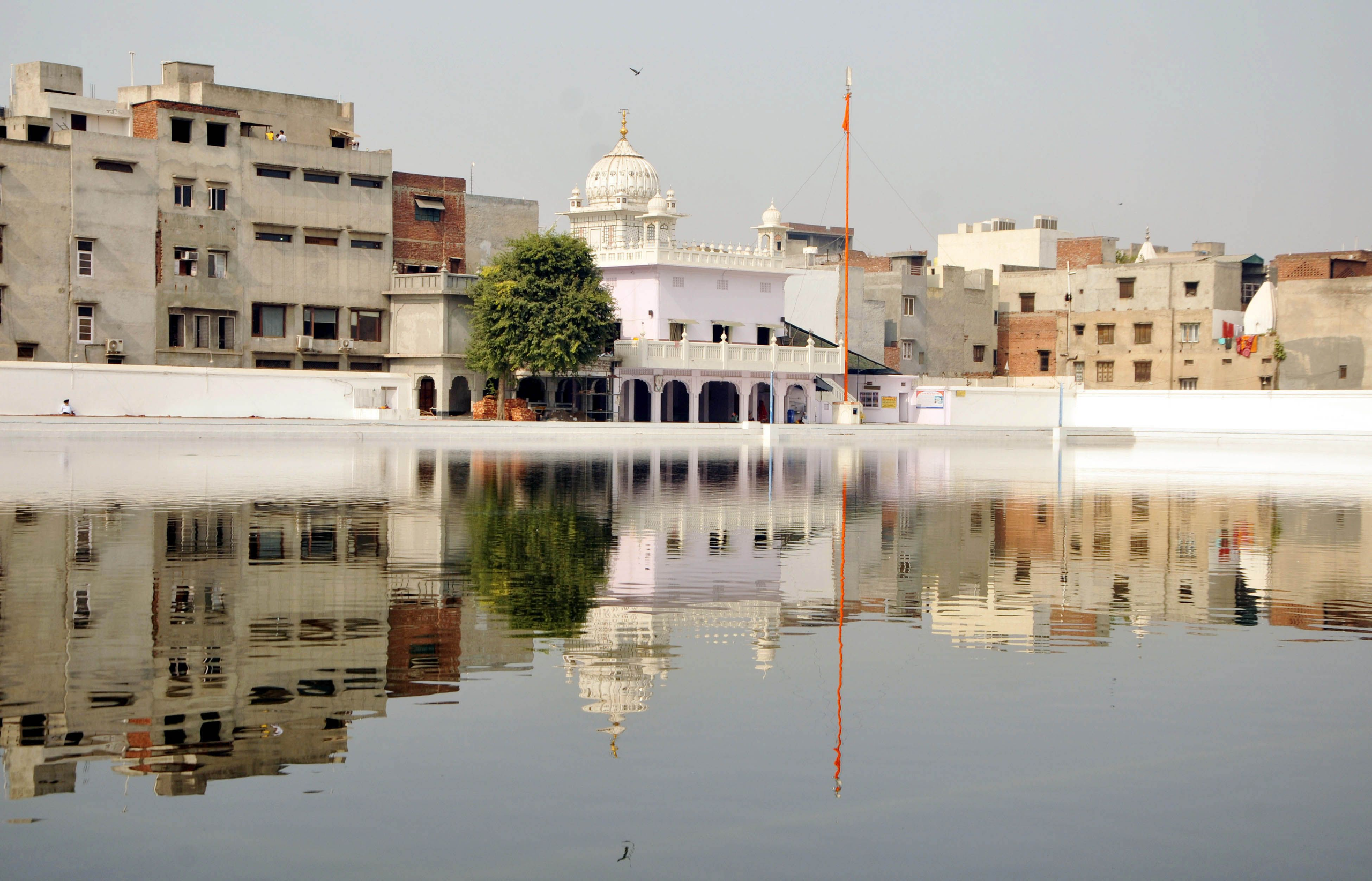
While the Golden Temple’s Amrit Sarovar remains the most widely recognised, four other historic Sikh sarovars — Santokhsar, Ramsar, Kaulsar and Bibeksar — collectively offer a fascinating account of the city’s formative centuries.
Santokhsar holds a particularly distinguished position in this heritage. Located approximately 700 metres from the Golden Temple, it is traditionally regarded as the earliest sarovar whose excavation was initiated by the Sikh Gurus.
Guru Ram Das began work on the pool before undertaking the Amrit Sarovar project, although Santokhsar was completed later, in 1589. Its name is associated with Baba Santokh, a saint who, according to tradition, was discovered meditating at the location.
The pool’s history also reflects the community’s commitment to safeguarding its sacred landmarks. After being filled in during the colonial period following an epidemic, Santokhsar was eventually restored through kar sewa, or voluntary community service, organised by Baba Sham Singh and Baba Gurmukh Singh.
A different aspect of Sikh heritage survives at Ramsar, the smallest of the five historic sarovars. Completed in 1603 under Guru Arjan Dev, the site is closely associated with the compilation of the Adi Granth, the foundational scripture of Sikhism.
The peaceful environment surrounding Ramsar provided a setting for this momentous literary and spiritual undertaking. Historical descriptions of the site evoke a landscape of trees and quiet surroundings, far removed from the bustle of the city that later developed around it.
Kaulsar, situated within the broader Golden Temple precinct, carries a story of personal devotion and spiritual conviction. The pool is associated with Bibi Kaulan, traditionally described as the daughter of a Qazi from Lahore who embraced the teachings of Sikhism.
Its excavation reportedly commenced in 1624 and concluded in 1627 under the supervision of Baba Buddha Ji, the first head granthi of the Golden Temple. The sarovar remains a reminder of the diverse personal journeys and expressions of faith woven into Sikh history.
Bibeksar, meanwhile, reflects another defining dimension of the Sikh tradition. Established by the sixth Sikh Guru, Guru Hargobind, the pool was associated with an area where Sikhs received training in martial arts and the use of weapons.
Its significance extends beyond religious observance, recalling an era when spiritual discipline and martial preparedness increasingly became intertwined in the development of the Sikh community.
A Heritage Beyond Religious Boundaries
Although the city’s five historic Sikh sarovars occupy a central place in its identity, Amritsar’s water heritage is not confined to Sikh shrines alone.
The Durgiana Sarovar, developed in 1930, is among the most prominent examples of the city’s wider religious landscape. Modelled architecturally on the Golden Temple complex, it surrounds a temple situated at its centre and continues to serve as an important venue for Hindu worship and religious celebrations.
Elsewhere, smaller and less celebrated water bodies preserve traces of an Amritsar that has gradually faded from public memory.
Ram Talai, located near an old temple along the historic Grand Trunk Road, is one such example. Its presence recalls a time when ponds and religious structures frequently developed together, becoming familiar landmarks for surrounding communities.
Historical references also mention the Kalyan Singh talaab, which acquired the name Distillery Dhab because of its proximity to a distillery during the British period. Such names offer glimpses into the changing relationship between the city’s natural geography, commercial activity and urban growth.
Together, these sites reveal how water bodies once served multiple purposes, functioning as spiritual destinations, geographical reference points and focal spaces around which neighbourhoods evolved.
Preserving the Memory of a City
The surviving sarovars of Amritsar represent an extraordinary continuity between the city’s origins and its present-day identity. Their significance lies not simply in their age or architectural surroundings, but in the historical experiences they embody.
Some witnessed the establishment of religious institutions, others became associated with the creation of sacred literature or the development of martial traditions. Several survived political upheavals, periods of neglect and changing approaches to urban development.
Their stories also illustrate the role of collective participation in preserving heritage. The restoration of historic pools through community-led efforts demonstrates how successive generations have sought to protect places considered essential to their cultural and spiritual inheritance.
As Amritsar continues to expand and modernise, these water bodies remain enduring reminders of the landscape from which the city emerged.
For visitors, they offer opportunities to discover a history that extends well beyond the familiar image of the Golden Temple. For residents, they form part of a shared inheritance connecting contemporary urban life with centuries of devotion, resilience and community endeavour.
In Amritsar, water has never been merely a feature of the landscape. It has shaped the city’s name, nurtured its spiritual traditions and witnessed its transformation through the centuries.
The sarovars, in many ways, remain the living chronicles of a city whose history was written around its sacred waters.