


AI Generated Summary
- Canadian commentator Daniel Boardman shared the teaser on social media, claiming that the violence at the Hindu Sabha Temple in Brampton and the reporting by Canada’s public broadcaster inspired him to make the documentary.
- Amid the ongoing controversy over pro-Khalistan activities in Canada, India–Canada relations, and the safety of the Hindu community, the teaser of the documentary Finding Khalistan once again raises serious questions.
- The history of the demand for Khalistan is linked to political disputes in Punjab, the violence of the 1980s, terrorism, and serious human rights violations.
Amid the ongoing controversy over pro-Khalistan activities in Canada, India–Canada relations, and the safety of the Hindu community, the teaser of the documentary Finding Khalistan once again raises serious questions. Canadian commentator Daniel Boardman shared the teaser on social media, claiming that the violence at the Hindu Sabha Temple in Brampton and the reporting by Canada’s public broadcaster inspired him to make the documentary. However, the accuracy of his claims and the film’s conclusions can only be independently verified after examining the complete documentary and the available evidence. Nevertheless, the central question is clear: Are Western countries doing enough to address the threats posed by violent extremism and risks to the safety of religious communities under the guise of freedom of expression?
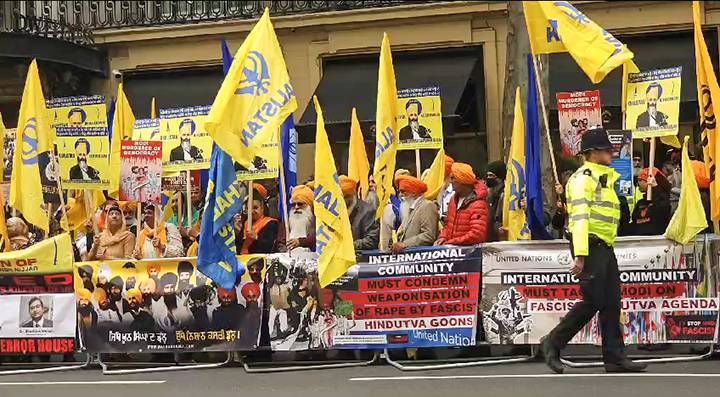
The violent clashes that took place outside the Hindu Sabha Temple in Brampton, Ontario, on November 3, 2024, made this question even more pressing. A confrontation broke out between protesters and others during an event providing consular services associated with the Indian consulate on the temple premises. Videos that emerged showed people assaulting one another with flagpoles and other objects. Police made arrests and initiated legal proceedings. This incident was not merely a local dispute; it raised questions about the security of religious sites, the rule of law, and the limits of political protest.
In a democracy, the right to peaceful protest is fundamental, but no one has the right to resort to violence. Opposing the presence of a government official is one thing; attacking people outside a temple is quite another. If any protester engaged in violence, issued threats, or intimidated a religious community, strict legal action should be taken on the basis of concrete evidence. Political slogans cannot place anyone above the law. Government and police inaction would be equally concerning, just as would be biased action against an innocent person.
The history of the demand for Khalistan is linked to political disputes in Punjab, the violence of the 1980s, terrorism, and serious human rights violations. It is important to discuss this history, but historical grievances cannot justify murder, threats, or attacks on religious sites today. Peaceful political ideas should be addressed through democratic debate, while criminal activities must be dealt with firmly under the law. The problem becomes even more serious when political objectives fuel mistrust between communities and allegations of violence are presented selectively. Millions of members of the Sikh community in Canada contribute to the country’s social, economic, and political life. Holding them collectively responsible for the actions of an extremist organisation or individual would be unjust. Similarly, dismissing the Hindu community’s concerns about its safety as merely a political controversy is unacceptable. Protecting Hindus and safeguarding the rights of the Sikh community are equally important responsibilities of a democratic system.
The media’s role in this controversy is also crucial. When violence occurs at a temple, the accounts of victims and eyewitnesses, along with facts verified by the police, must receive adequate attention. At the same time, a broadcast should not be labelled biased without examining its actual content. It is reasonable to expect impartiality and transparency from public broadcasters, but allegations must be judged on the basis of evidence rather than political assumptions. The media’s role is neither to normalise violence nor to sensationalise events or place an entire community in the dock.
The actual value of Finding Khalistan will also be determined by the same standards. If the documentary presents its conclusions on the basis of historical records, credible evidence, eyewitness accounts, and independently verified events, it could contribute meaningfully to an important public debate. However, declaring the film either conclusive proof or propaganda merely on the basis of its teaser would be premature. Serious journalism requires the verification of claims, clarity of context, and the willingness to revise conclusions honestly when they are proven wrong.
India–Canada relations are also passing through a period of tension over this issue. The killing of Hardeep Singh Nijjar in Canada in June 2023 triggered a serious diplomatic dispute between the two countries. Canada levelled allegations involving Indian officials, which India rejected. These allegations and the violence at the Brampton temple must be examined as separate incidents, each within its own evidentiary and legal context. However, the broader tensions must not compromise the safety of ordinary citizens and diaspora communities.
The Canadian government now has a clear responsibility to strengthen the security of religious sites, ensure impartial investigations into violence and threats, and take action against those found guilty in accordance with the law. The Indian government, too, must firmly raise the issue of the safety of the Indian diaspora through diplomatic channels. Both countries should move beyond political rhetoric and prioritise investigations, evidence, and accountability.
Western democracies must understand that freedom of expression does not mean tolerating violence. Criticising an ideology is a democratic right, but intimidating or attacking a religious community is a crime. Likewise, spreading hatred against an entire community while opposing violence is no solution.
The time has come to move beyond ambiguous statements and demand clear accountability. The security of all religious sites, including temples and gurdwaras, must be ensured; those responsible for violence must face impartial legal action; and a clear distinction must be maintained between political beliefs and criminal activities. Pro-Khalistan politics must be debated on the basis of facts, without fear and without collective blame. Ultimately, the credibility of any democracy is determined not by its slogans, but by how firmly it upholds the principles of public safety, the rule of law, and justice.