


AI Generated Summary
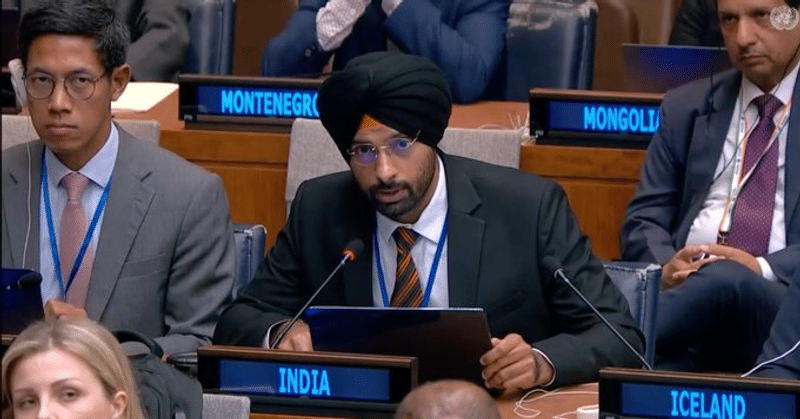
- Bedi was recently in the spotlight after representing India during the working methods debate of the First Committee at the 81st Session of the United Nations General Assembly, where he underlined the need to restore trust in the multilateral system and linked that objective to long-pending reform of the UN Security Council.
- For the young diplomat from Amritsar who chose the Foreign Service after finishing second in the country in the civil services examination, it is also a continuation of the path he chose at the very beginning of his career.
- He has also served as a Friend of the Chair in the Working Group on the strengthening of the Biological Weapons Convention, contributing to negotiations surrounding an important component of the international disarmament architecture.
From securing the second rank in one of India’s most competitive examinations to representing the country on the global diplomatic stage, Amritsar-born Indian Foreign Service officer Anmol Sher Singh Bedi has emerged as a prominent young Indian diplomat working on international security and disarmament.
Bedi was recently in the spotlight after representing India during the working methods debate of the First Committee at the 81st Session of the United Nations General Assembly, where he underlined the need to restore trust in the multilateral system and linked that objective to long-pending reform of the UN Security Council.
“Trust is the core currency of the multilateral system. Restoring that trust must begin where reform is most needed: the UN Security Council,” Bedi wrote on X following the debate.
For the Amritsar native, the appearance is the latest milestone in a journey that first drew national attention nearly a decade ago.
Bedi secured All India Rank 2 in the UPSC Civil Services Examination 2016, emerging as the highest-ranked male candidate in the country. Unlike many candidates at the top of the Civil Services list who opt for the Indian Administrative Service, Bedi had expressed his desire to join the Indian Foreign Service, setting his sights on a career representing India abroad.
An engineer by education, Bedi graduated in Computer Science from BITS Pilani. He had earlier completed his schooling in Amritsar.
His performance continued after entering the Foreign Service. During his diplomatic training, Bedi was recognised as the Best Officer Trainee of his batch, earning the External Affairs Minister’s Gold Medal.
A 2017-batch IFS officer, Bedi went on to work at the Ministry of External Affairs in New Delhi before assuming responsibilities connected with India’s multilateral diplomacy in Geneva.
He currently serves as Senior Adviser (Disarmament) at India’s Permanent Mission to the Conference on Disarmament in Geneva, placing him in an arena dealing with some of the most consequential questions of international security.
His diplomatic work has covered areas ranging from nuclear disarmament and arms control to outer-space security and biological weapons. He has also served as a Friend of the Chair in the Working Group on the strengthening of the Biological Weapons Convention, contributing to negotiations surrounding an important component of the international disarmament architecture.
His latest intervention at the United Nations centred on an issue India has championed for years — reform of the Security Council.
New Delhi has consistently argued that the Council’s present structure does not adequately reflect contemporary geopolitical realities or provide sufficient representation to developing countries. India has sought expansion of both permanent and non-permanent membership as part of wider reforms aimed at making the institution more representative and effective.
For Bedi, however, the argument was framed around something even more fundamental: trust.
His contention that confidence in multilateralism must be rebuilt by reforming the institutions at its core brought together two themes that have increasingly shaped India’s international diplomacy — greater representation for the developing world and reform of global institutions created for a very different era.
For the young diplomat from Amritsar who chose the Foreign Service after finishing second in the country in the civil services examination, it is also a continuation of the path he chose at the very beginning of his career: taking India’s voice to the international stage.