


AI Generated Summary
- While some residents describe the old saying as a curse upon the town’s tendency towards factionalism, others see the second part of the tradition as a blessing — an assurance that respected elders can come together when necessary and settle matters fairly.
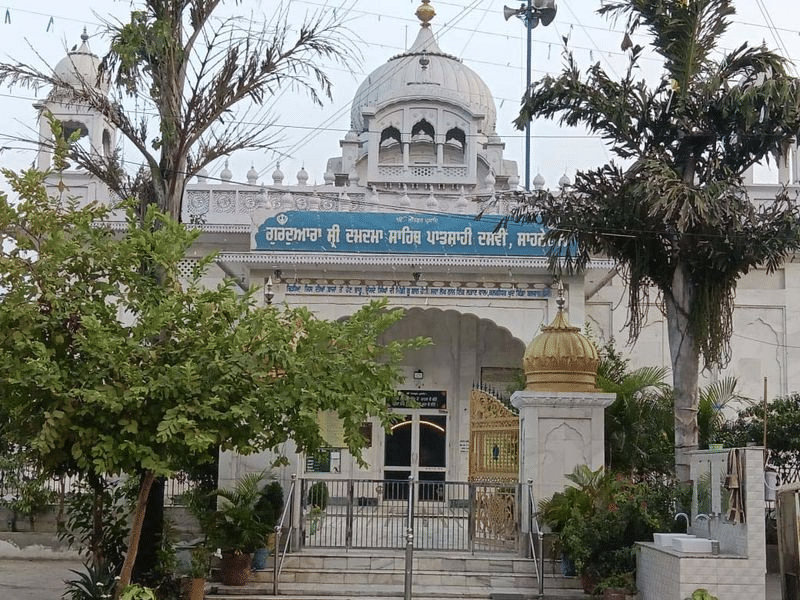
- Tucked away from the bustle of the highway, Gurdwara Damdama Sahib in Sahnewal preserves the memory of a brief but poignant halt in Guru Gobind Singh’s journey following the Battle of Chamkaur.
- According to the story preserved in the town, the villagers formed a circle — or ghera — around the Guru, pleading with him not to leave them with those words.
Tucked away from the bustle of the highway, Gurdwara Damdama Sahib in Sahnewal preserves the memory of a brief but poignant halt in Guru Gobind Singh’s journey following the Battle of Chamkaur.
The shrine is associated with the Guru’s passage through the region in December 1704, after he left Chamkaur Sahib, where his elder sons, Baba Ajit Singh and Baba Jujhar Singh, attained martyrdom along with nearly 40 Sikhs.
According to accounts passed down locally, Guru Gobind Singh travelled onwards disguised as Uch Da Pir. He was carried in a palanquin with the assistance of Bhai Ghani Khan and Bhai Nabi Khan, two Afghan brothers who helped him during his journey. His route took him through Machhiwara and Alamgir towards the Malwa region. The historic path later came to be associated with Guru Gobind Singh Marg.
It was during this journey, local tradition holds, that the Guru stopped at Sahnewal and rested beneath a Karir tree.
The halt gave the place its name. “Damdama” is understood as a place to pause, rest or catch one’s breath. The better-known Damdama Sahib at Talwandi Sabo is also associated with the same idea of a place of repose.
But in Sahnewal, the story of the Guru’s halt is remembered for another reason — an exchange that residents continue to recount more than three centuries later.
Local tradition says that while resting, Guru Gobind Singh asked a passerby about the village panchayat. The man reportedly responded casually that there was no panchayat in Sahnewal.
The Guru is then said to have remarked, in effect, that if that was how things stood, the village would remain without one.
By the time villagers realised the identity of the traveller who had stopped among them, regret had set in. They hurried after the Guru and caught up with his palanquin a short distance away.
That spot is today remembered as Ghera Sahib.
According to the story preserved in the town, the villagers formed a circle — or ghera — around the Guru, pleading with him not to leave them with those words.
Their remorse brought a different response. The Guru is said to have blessed the people, telling them that the village’s wise elders would sit together and resolve disputes and matters of importance with justice.
For residents of Sahnewal, the episode is not simply an account from the distant past. It remains part of the town’s living folklore and is frequently invoked while discussing its civic life.
“Baba Ji di gal sach ho gayi” — the Guru’s words have come true — is a refrain still heard around the shrine.
Some residents interpret the story through Sahnewal’s continuing difficulty in building consensus on local issues.
“Everyone seems to have their own agenda,” said Manjinder Singh Bhola, a resident of the town. “Even when somebody wants people to come together for something good, getting everyone on the same page becomes difficult. What Guru Sahib said about there being no panchayat still feels true.”
Interpretations, however, differ. While some residents describe the old saying as a curse upon the town’s tendency towards factionalism, others see the second part of the tradition as a blessing — an assurance that respected elders can come together when necessary and settle matters fairly.
Today, Gurdwara Damdama Sahib remains a modest and tranquil shrine. A tall Nishan Sahib marks its presence, while its small prayer hall hosts daily prayers and kirtan. Langar is also served.
For years, the gurdwara attracted relatively little attention from travellers passing along the nearby highway, but religious activity at the shrine has gradually become more visible.
Unlike Takht Sri Damdama Sahib at Talwandi Sabo, celebrated in Sikh tradition as Guru Ki Kashi, Sahnewal’s Damdama Sahib carries a quieter memory.
It recalls a Guru travelling through Punjab after one of the most devastating episodes of his life; a brief pause beneath a tree; villagers who realised too late whom they had encountered; and a moment of remorse that, according to local belief, ended not in condemnation but in reconciliation and blessing.
More than three centuries later, that story remains woven into Sahnewal’s understanding of itself.
