


AI Generated Summary
- It incorporates roughly 15 to 20 per cent of the straw into the soil ahead of its furrow openers while leaving the remainder between the furrows on the surface.
- Agricultural experts are therefore urging farmers to look at paddy straw not simply as waste that needs to be cleared, but as a resource that can either be retained in the field or collected for productive use elsewhere.
- in-situ management, in which straw remains within the field and is incorporated into or retained over the soil, and ex-situ management, in which residue is collected and used elsewhere.
As Punjab enters another paddy harvesting season, the state is once again confronted with a problem that has become almost synonymous with this time of year: what to do with millions of tonnes of crop residue left behind in the fields.
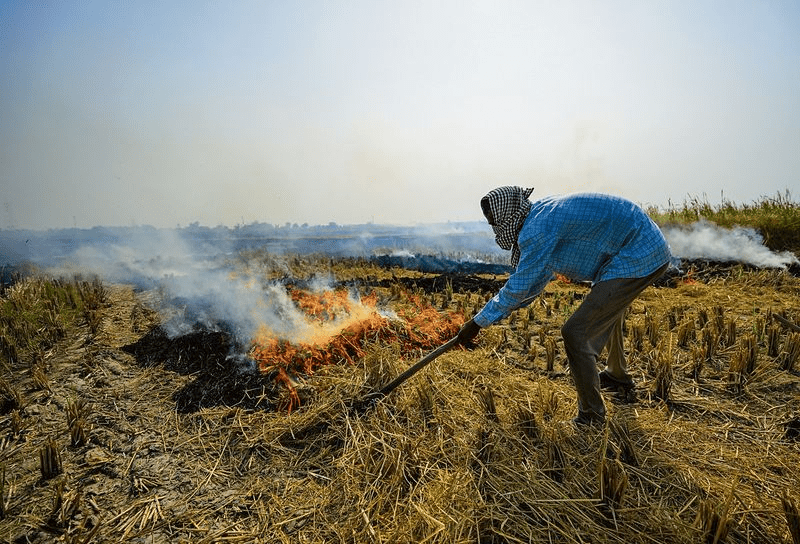
For farmers preparing to sow wheat soon after harvesting paddy, the window between the two crops is narrow. Clearing fields quickly is essential, and setting fire to the remaining straw has traditionally offered a cheap and rapid solution. But the practice comes at a considerable cost — not only through worsening air pollution, but also through the gradual loss of nutrients and biological activity from agricultural soil.
Agricultural experts are therefore urging farmers to look at paddy straw not simply as waste that needs to be cleared, but as a resource that can either be retained in the field or collected for productive use elsewhere.
What the soil loses when straw burns
The impact of crop-residue burning begins in the field itself. An estimated 10 quintals of paddy straw contains about 400 kg of organic carbon, 5.5 kg of nitrogen, 2.3 kg of phosphorus, 25 kg of potassium and 1.2 kg of sulphur.
When the residue is burned, much of this potential nutrient value is lost. Managing the straw instead allows some of these nutrients and organic matter to return to the soil, potentially improving fertility and reducing dependence on synthetic fertilisers in subsequent crops.
Fire also damages the living ecosystem of the soil, killing beneficial microorganisms and insects. Beyond the farm, smoke from burning residue releases particulate matter and gases into the atmosphere, adding to environmental and public-health concerns during the harvesting season.
Alok Gupta of Punjab Agricultural University’s Krishi Vigyan Kendra has described management of the straw remaining after paddy harvesting as a major challenge for Punjab’s farmers and other stakeholders.
The university is advocating two broad approaches: in-situ management, in which straw remains within the field and is incorporated into or retained over the soil, and ex-situ management, in which residue is collected and used elsewhere.
Sowing wheat without burning the residue
Mechanisation has expanded the options available to farmers who want to sow wheat while retaining paddy straw.
Among the technologies recommended by Punjab Agricultural University are the Surface Seeder, Smart Seeder, Happy Seeder and Super Seeder. Each handles the residue differently, allowing farmers to choose a method suited to their field conditions, available machinery and operational requirements.
The Surface Seeder offers one of the lower-cost approaches. Wheat can be sown for approximately Rs 700-800 per acre without either burning the residue or carrying out conventional tillage. Operated with a 45-horsepower tractor, the machine can cover roughly 1.5 acres an hour.
During sowing, it places seed and fertiliser while spreading paddy straw evenly over the surface. The resulting layer of residue acts as mulch, helping suppress weeds, moderate soil temperature and improve soil conditions.
For this method, PAU recommends wheat sowing from late October through the first fortnight of November. Paddy should preferably be harvested using a combine equipped with a Super Straw Management System, or Super SMS, while maintaining stubble of around four to five inches. The recommended quantities are about 45 kg of wheat seed and 65 kg of DAP per acre.
The Smart Seeder takes a hybrid approach. It incorporates roughly 15 to 20 per cent of the straw into the soil ahead of its furrow openers while leaving the remainder between the furrows on the surface. The machine can cover approximately seven to eight acres in a day and can also help check weed germination.
The Happy Seeder, meanwhile, enables wheat to be planted directly without first removing paddy residue. Its flail-type blades cut straw in front of the furrow openers, after which the residue remains on the field as mulch. It can typically sow around six to seven acres a day. Uniform distribution of straw — preferably through a combine fitted with Super SMS — is important for effective operation.
Farmers wanting greater incorporation of residue into the soil can use the Super Seeder. The machine uses a rotavator to mix straw into the soil before the wheat is sown and can cover roughly 4.5 to 5.5 acres in a day.
The Super SMS, rather than being a wheat-sowing machine itself, works during paddy harvesting. Attached to the rear of a combine harvester, it chops the discharged straw into smaller pieces and distributes them uniformly across the field, making subsequent residue-management operations easier.
Ranvir Singh of PAU’s Krishi Vigyan Kendra has said that farmers can choose among these technologies depending upon their individual field conditions and requirements.
Straw need not remain in the field
Retaining residue is not the only alternative to burning it. Where farmers prefer to clear their land, straw can be collected using balers and transported for other uses.
This opens another potential pathway in which what was once considered an agricultural burden becomes a raw material.
Collected paddy straw can be used for biogas production, mushroom cultivation, packaging material and mulching. It can also serve as fuel in straw-based geysers.
There are uses within livestock farming as well. After appropriate urea treatment, paddy straw can be utilised as animal fodder. Straw used as dry bedding for cattle can subsequently decompose and be converted into organic manure.
These alternatives are particularly significant because Punjab’s stubble problem cannot necessarily be addressed through a single machine or farming practice. Fields vary in size and conditions, farmers have different access to machinery, and residue can potentially have economic value beyond the farm.
The larger objective, agricultural experts say, is to bring as much cultivated area as possible under some form of residue management rather than allowing fire to remain the default method of clearing fields.
Ajitpal Singh Dhaliwal of PAU has stressed the need to maximise acreage under straw management, pointing to its potential to protect and enrich soil while reducing environmental damage.
The choice facing Punjab, therefore, extends beyond preventing smoke during a few weeks of the year. Every tonne of straw burned represents organic matter and nutrients removed from the agricultural cycle. Managed properly, the same residue can protect the soil, contribute to future crops or become an input for other economic activities.
As harvesting gathers pace, the challenge is increasingly not whether alternatives to stubble burning exist. A range of technologies and uses are already available. The more consequential question is how widely and effectively they can be adopted across Punjab’s farms.
