


AI Generated Summary
- His younger brother, Saroop Singh Dhatt, joined the Indian Police Service and served in Maharashtra, while one of his sisters completed an MSc in Political Science and later became an assistant professor in the United States.
- He cleared the Indian Forest Service examination and spent four years in the Forest Department before choosing a life in uniform and joining the Army.
- Singh continued his education at Khalsa High School in Garhdiwala before securing admission to DAV College, Jalandhar, for a BSc under a freeship programme available to only 11 students.
At 15, Manmohan Singh left behind the only home he had known and boarded a train from Lyallpur to Amritsar with his father. Nearly eight decades later, the memory of that journey remains vivid — not only because of what the family lost, but because of how narrowly they escaped the violence that engulfed the subcontinent during Partition.
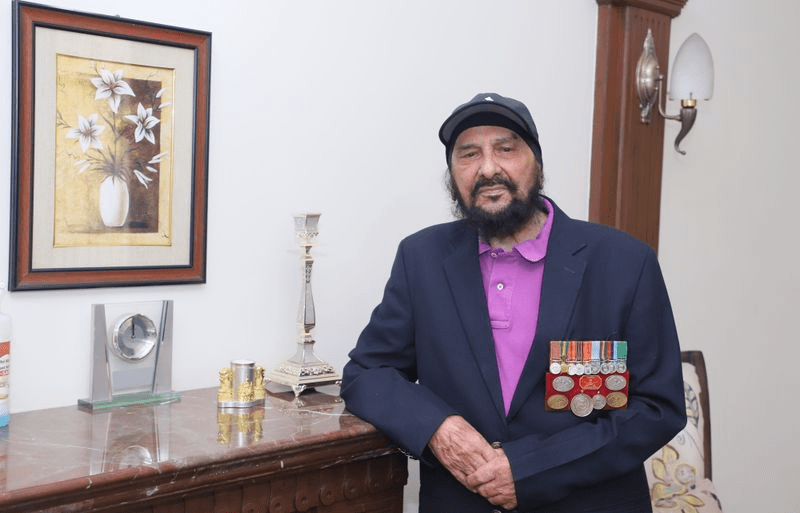
Now 94, Lt Col Manmohan Singh (retd), former Deputy Director of Sainik Welfare, Jalandhar, remembers arriving safely in India and making his way to his paternal uncle’s home in Hoshiarpur. There, he and his father were reunited with his mother and five younger siblings, who had crossed the border earlier.
Only afterwards did the family realise how fortunate they had been. Their train, Singh recalls, was among the last to reach Amritsar safely before large-scale violence broke out along the route.
The family had delayed leaving Pakistan because their roots there were not easy to abandon. They owned milch cattle in Gojra tehsil, and Singh’s father, Santokh Singh, a schoolteacher, had initially stayed behind with his eldest son to look after them. The rest of the family was sent ahead to India.
But as the situation deteriorated, staying on was no longer possible. Father and son finally left, carrying with them little more than their memories and the hope of being reunited with their family.
An education that survived displacement
If Partition uprooted Singh geographically, it did little to weaken the values instilled in him during his childhood.
His father was a demanding teacher who placed extraordinary emphasis on education. Singh still remembers returning home delighted after scoring 49 out of 50 in science. He expected appreciation. Instead, his father wanted to know why he had lost the remaining mark.
That insistence on academic excellence would remain with Singh throughout his life.
His early schooling in Pakistan also introduced him to Persian and sparked an enduring fascination with languages. Decades later, even after studying science and serving in the Army, that interest led him to complete an MA in Urdu from Jamia Millia Islamia.
The family, however, suffered another devastating blow soon after rebuilding its life in India. Santokh Singh died in 1948, leaving the teenage Manmohan as the eldest child in a household with five younger siblings.
Responsibility arrived early.
His mother ensured that hardship did not become an excuse for neglecting education. An early riser herself, she would wake the children at 4 am so they could study before school.
Singh continued his education at Khalsa High School in Garhdiwala before securing admission to DAV College, Jalandhar, for a BSc under a freeship programme available to only 11 students. He subsequently completed an MSc in Physics from SCD Government College, Ludhiana. Among his memories of those years is that celebrated poet Sahir Ludhianvi was about a year and a half senior to him.
Family before self
Singh’s professional journey took several turns. He cleared the Indian Forest Service examination and spent four years in the Forest Department before choosing a life in uniform and joining the Army.
Yet behind his professional achievements ran another, quieter commitment — raising and educating the family his father had left behind.
With three younger sisters and two brothers depending upon him, Singh decided against marriage. For him, it was a practical and deeply personal choice: the education and future of his siblings came first.
The sacrifices bore fruit. His younger brother, Saroop Singh Dhatt, joined the Indian Police Service and served in Maharashtra, while one of his sisters completed an MSc in Political Science and later became an assistant professor in the United States.
Singh would eventually experience fatherhood in another form. He brought his young nephew from the village, raised him and took responsibility for his education and mentoring.
That nephew was Ranbir Singh, who would rise through the ranks of the Indian Army to become Lieutenant General and serve as Director General of Military Operations. Lt Gen Ranbir Singh (retd) later came to national prominence in connection with the planning of the surgical strikes following the Uri terror attack.
For Manmohan Singh, his nephew’s journey became another chapter in a family story built around education, discipline and public service.
Service that continued beyond retirement
Singh’s commitment to the armed forces did not end when he took off his uniform. As Deputy Director of Sainik Welfare in Jalandhar, he devoted himself to veterans, young aspirants and civic programmes.
Remarkably, he continued working even after completing his formal tenure, accepting a token salary of Re 1 per month.
For more than two decades, he remained closely associated with district-level Independence Day and Republic Day programmes. Preparations were exacting. Children participating in cultural and patriotic presentations underwent weeks of training, while NCC cadets were drilled with particular attention to discipline and precision.
The effort showed in competition. Under his supervision, NCC contingents repeatedly won recognition for their parades, at times finishing ahead of police and paramilitary contingents.
His office also became a training ground for young people hoping to enter the armed forces. More than 3,000 aspirants underwent pre-recruitment training during his tenure.
For a man whose adolescence was marked by displacement, Singh’s later life became closely intertwined with institutions that represented stability, discipline and nation-building.
His story also reflects a generation for whom Partition was not merely a chapter in a history book. It was an abrupt rupture between childhood and adulthood — between homes abandoned and lives reconstructed almost from scratch.
Singh lost his birthplace, then his father, and assumed family responsibilities while still young. Yet displacement did not interrupt his pursuit of education, nor did personal sacrifice diminish his appetite for service.
From a 15-year-old refugee travelling anxiously towards Amritsar to an Army officer, educator, mentor and veterans’ welfare administrator, Lt Col Manmohan Singh’s life spans almost the entire journey of independent India.
At 94, the memories of Lyallpur and that fortunate train journey remain with him. But so does something larger: the record of a life spent turning survival into responsibility, and responsibility into service.