


AI Generated Summary
- A visit to Delhi in search of a suitable UPSC coaching institute for his daughter nearly a decade ago gave Ludhiana Police Assistant Sub-Inspector Gurdev Singh an unexpected mission — to make quality coaching for government examinations accessible to students who could not afford it.
- The steep cost of preparing for the civil services in the national capital left an impression on Singh, who is currently posted as a head clerk with the Ludhiana Police Commissionerate.
- What began as an attempt to bridge the financial gap in competitive examination preparation has since developed into a residential coaching programme drawing aspirants from Punjab and other parts of the country.
A visit to Delhi in search of a suitable UPSC coaching institute for his daughter nearly a decade ago gave Ludhiana Police Assistant Sub-Inspector Gurdev Singh an unexpected mission — to make quality coaching for government examinations accessible to students who could not afford it.
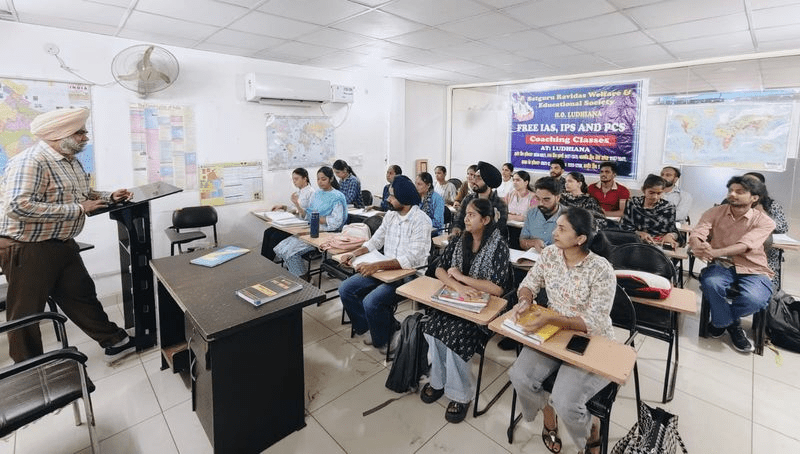
The steep cost of preparing for the civil services in the national capital left an impression on Singh, who is currently posted as a head clerk with the Ludhiana Police Commissionerate. In 2016, he turned that concern into an initiative by establishing the Satguru Ravidas Welfare and Educational Society, which provides free coaching as well as food and accommodation to students from economically weaker families.
Singh recalls being quoted nearly Rs 5 lakh for his daughter’s coaching and stay when he approached a reputed UPSC institute in Delhi. While the amount was within his means, it made him wonder how talented students from low-income households could hope to compete when the cost of preparation itself was beyond their reach.
That question became the foundation of the society.
Singh reached out to fellow police personnel, social workers and members of the NRI community who shared his concerns and were willing to support the effort. What began as an attempt to bridge the financial gap in competitive examination preparation has since developed into a residential coaching programme drawing aspirants from Punjab and other parts of the country.
Admission to the centre is offered through an entrance examination to students whose annual family income does not exceed Rs 2.5 lakh. Each year, the society selects a batch of 50 aspirants. The current batch comprises 35 male and 15 female students.
Classes are held throughout the week and are conducted by experienced faculty members, including teachers who have previously been associated with established UPSC coaching institutes in Delhi. Along with classroom preparation, students receive free accommodation and meals, reducing some of the major expenses that often prevent aspirants from disadvantaged families from pursuing competitive examinations.
Over the years, the centre has attracted students not only from Punjab but also from Jammu and Kashmir, Rajasthan and Karnataka.
Its alumni have gone on to secure positions across a range of government departments. Former students have been selected as sub-inspectors in Punjab Police and Delhi Police, jail wardens, revenue officials, teachers and railway employees. The centre has also produced a successful judicial services candidate who went on to become a Judicial Magistrate First Class.
Some aspirants have progressed as far as the UPSC Civil Services Mains examination, though they could not clear the final interview stage.
Among those whose careers were shaped by the initiative is Singh’s own daughter, who became a sub-inspector in Punjab Police. Other beneficiaries include Jaskiran Kaur, who was also selected as a Punjab Police sub-inspector, and Jagjit Kaur, who joined the force as a constable.
The initiative is now seeking to strengthen its preparation for the more demanding stages of the civil services examination. The society has begun inviting serving IAS and IPS officers to interact with students and offer insights into examination strategy, administration and the personality test. IPS officer Abhinav Jain was among the officers who recently addressed aspirants at the centre.
Perhaps one of the clearest indications of the programme’s impact is that some of its former students have returned to help the next generation.
Jaspal Singh joined the centre’s first batch in 2016 with aspirations of becoming an IPS officer. The son of a farmer, he did not have the financial resources for expensive private coaching. Although he could not reach the UPSC interview stage, he subsequently secured a government position as a senior industrial officer in the Industry Department.
Since 2017, Jaspal has also been teaching UPSC aspirants at the same centre where he once studied.
For Gurdev Singh, the journey that began with a parent’s search for coaching for his own child has consequently grown into something much larger. By bringing together teachers, police personnel, social workers, serving officers and former students, the initiative has created an alternative support system for aspirants whose ambitions might otherwise have been restricted by the cost of preparation.
Nearly a decade after its inception, the society continues to work on the principle that a student’s chances of entering public service should depend on ability and perseverance — not on whether the family can afford a costly coaching institute.