

AI Generated Summary
- a Khalistan flag flying at one of the raided properties in Stockton, a city long identified as a hotbed of extremist Khalistani criminal activity.
- Home to one of the oldest Sikh gurdwaras in the United States, the area has repeatedly surfaced in reports of gang violence, extortion targeting Punjabi communities, threats, and shootings linked to syndicates like Bishnoi’s.
- Far from the state-sponsored narrative initially pushed by Canadian officials, this emerges as a brutal chapter in a Khalistani-linked gang war—fought over control of drug routes, extortion rackets, and influence in diaspora gurdwaras.
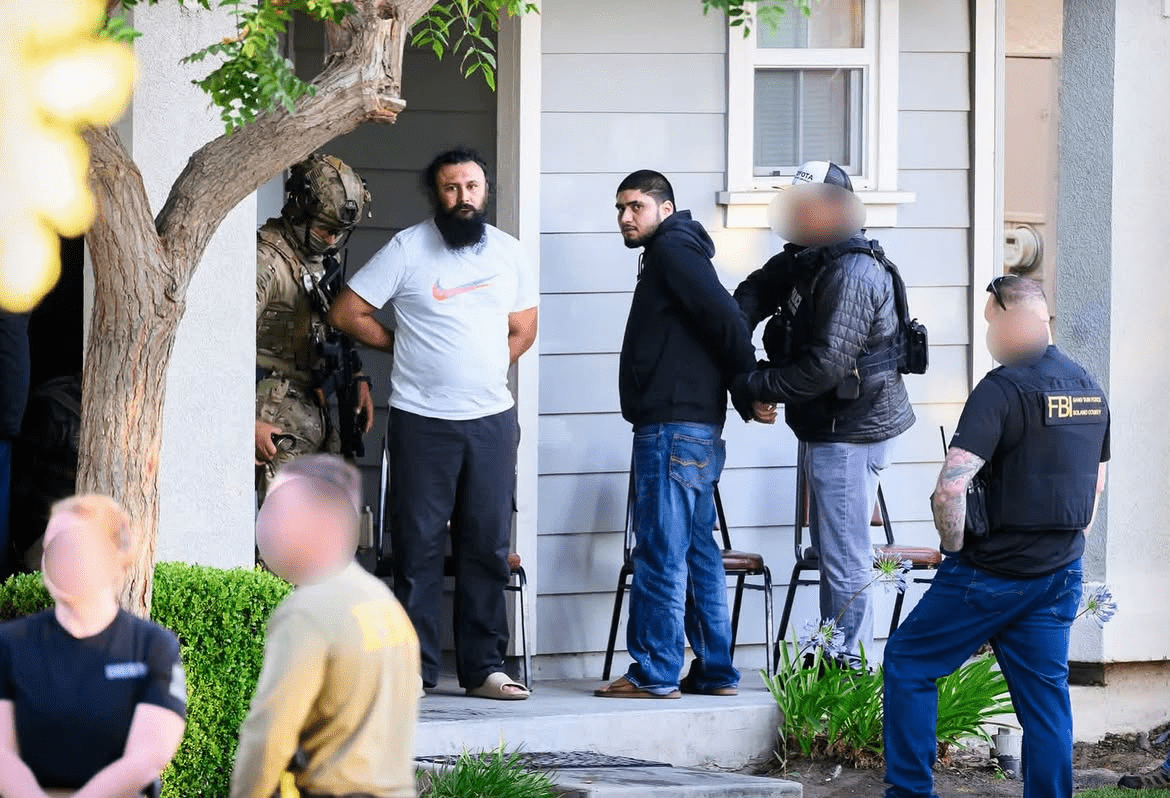
This week, the FBI’s “Operation Hard Ball” delivered a stark reminder of the transnational threat lurking in plain sight within certain segments of the Indian diaspora. In raids across California, including Stockton, agents dismantled parts of the notorious Lawrence Bishnoi crime syndicate—arresting suspects on charges ranging from drug trafficking and extortion to racketeering and targeted killings. Among the evidence: a Khalistan flag flying at one of the raided properties in Stockton, a city long identified as a hotbed of extremist Khalistani criminal activity.
Photographs from the operation show law enforcement surrounding homes, making arrests, and uncovering the paraphernalia of a violent enterprise. This wasn’t abstract activism. It was the visible intersection of organized crime and separatist symbolism.
Stockton’s significance cannot be overstated. Home to one of the oldest Sikh gurdwaras in the United States, the area has repeatedly surfaced in reports of gang violence, extortion targeting Punjabi communities, threats, and shootings linked to syndicates like Bishnoi’s. Local Sikhs have described living under a campaign of terror from these networks, which exploit diaspora ties for narcotics smuggling, weapons, and intimidation. The discovery of the Khalistan flag during the raid underscores how separatist ideology often serves as both cover and motivator for criminal enterprises.
The operation’s most explosive revelation ties directly to a case that roiled international relations: the 2023 assassination of Hardeep Singh Nijjar outside a gurdwara in Surrey, British Columbia. U.S. indictments now charge imprisoned gangster Lawrence Bishnoi and his Canada-based associate Goldy Brar with ordering the hit. Prosecutors allege Bishnoi directed operatives from his jail cell via smuggled phones, providing photos and addresses of Nijjar. Far from the state-sponsored narrative initially pushed by Canadian officials, this emerges as a brutal chapter in a Khalistani-linked gang war—fought over control of drug routes, extortion rackets, and influence in diaspora gurdwaras.
Nijjar himself was a prominent Khalistan advocate, and the Bishnoi network has been accused of leveraging such causes to legitimize violence and terrorize communities. RCMP and FBI coordination in Operation Hard Ball highlights the reality: these are criminal syndicates, not freedom fighters. They traffic in cocaine and heroin by the ton, extort families, and settle scores with bullets—often wrapping their operations in the flag of Khalistan to recruit and intimidate.
This should prompt a reckoning. For too long, Western governments have tiptoed around Khalistani extremism, treating noisy diaspora protests and temple politics as legitimate advocacy while downplaying links to terrorism designations, assassinations in India, and now proven gang warfare abroad. Canada’s earlier accusations against India over Nijjar strained diplomacy without, as these indictments suggest, holding up under scrutiny of the actual perpetrators. Meanwhile, communities in places like Stockton and Surrey pay the price in fear and bloodshed.
The Bishnoi gang’s playbook—jailhouse commands via contraband phones, international operatives, and fusion of crime with separatism—mirrors other hybrid threats. Ignoring it under the guise of multiculturalism enables predators who prey on their own communities. Law enforcement actions like Operation Hard Ball are welcome, but they must be paired with broader vigilance: stricter scrutiny of foreign funding to gurdwaras, deportation of criminal elements, and rejection of the false equivalence between cultural pride and support for violent separatism.
Khalistan as an ethno-religious state project has NO SUPPORT in India’s Punjab, where Sikhs thrive within the world’s largest democracy. Abroad, its loudest champions too often blur into gangsterism. The flag in Stockton isn’t a symbol of liberation—it’s a banner over a crime scene. Until policymakers confront this entanglement of extremism and organized crime head-on, raids will remain necessary, but insufficient. Diaspora communities deserve safety, not imported turf wars.