


AI Generated Summary
- The UAE President was personally received at the airport by the Prime Minister, a gesture officials said reflected the depth of trust and warmth between the two leaders.
- The significance of the engagement was further underscored by the composition of the visiting delegation, which included senior ministers and members of the ruling families of Abu Dhabi and Dubai.
- India and the United Arab Emirates on Monday sent out a firm and coordinated message against terrorism, with both countries reaffirming that there can be no justification for violence in any form, including cross-border terror activities.
India and the United Arab Emirates on Monday sent out a firm and coordinated message against terrorism, with both countries reaffirming that there can be no justification for violence in any form, including cross-border terror activities. The emphasis, leaders said, must remain on ensuring that no nation offers shelter or support—financial or otherwise—to individuals or networks involved in planning or executing terrorist acts.
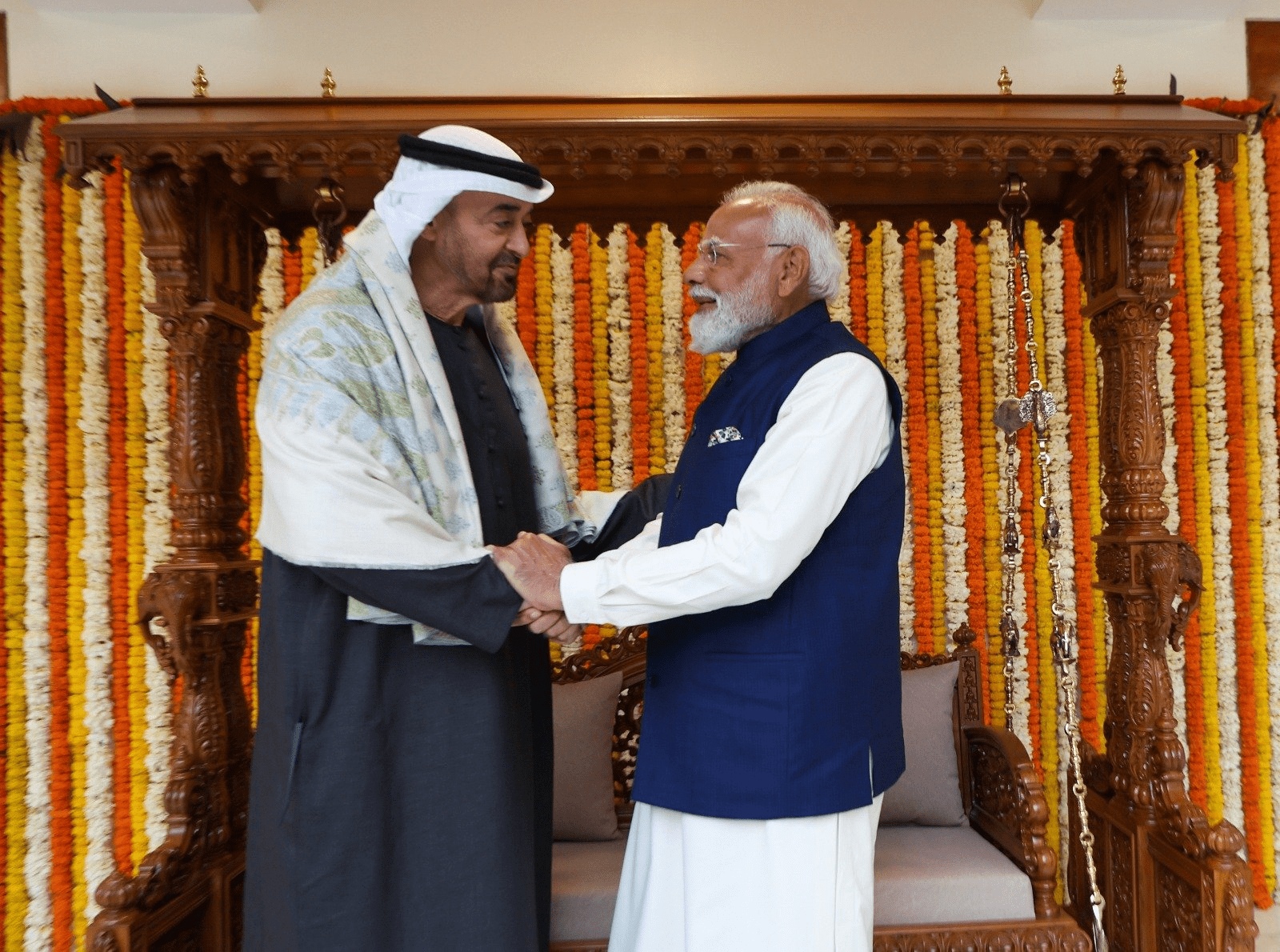
The strong articulation came during talks between Prime Minister Narendra Modi and UAE President Sheikh Mohamed bin Zayed Al Nahyan, who was in India on a brief but high-profile visit. The discussions culminated in a joint statement that underlined enhanced cooperation to counter terror financing and strengthen global safeguards against money laundering, particularly within the framework of the Financial Action Task Force.
Despite lasting only a few hours, the visit was marked by strong diplomatic symbolism. The UAE President was personally received at the airport by the Prime Minister, a gesture officials said reflected the depth of trust and warmth between the two leaders. The significance of the engagement was further underscored by the composition of the visiting delegation, which included senior ministers and members of the ruling families of Abu Dhabi and Dubai.
Beyond security, the talks ranged widely across regional and global developments. The leaders exchanged views on unfolding situations in West Asia, including conflicts in Gaza and Yemen, as well as developments concerning Iran. While details were not disclosed, officials described the exchange as candid and comprehensive.
Economic cooperation formed a major pillar of the discussions. The two sides reviewed the impact of the India-UAE Comprehensive Economic Partnership Agreement, noting that bilateral trade had crossed the $100 billion mark in the last financial year. Both leaders agreed to work towards doubling trade volumes to $200 billion by 2032, with a renewed push for initiatives aimed at integrating small and medium enterprises into cross-border supply chains.
Investment collaboration also featured prominently. The UAE was invited to deepen its participation in large-scale Indian infrastructure projects, including the Dholera Special Investment Region, while sovereign wealth funds from the Gulf nation were encouraged to explore opportunities in India’s upcoming National Infrastructure Investment Fund. The expansion of UAE financial institutions into Gujarat’s GIFT City was highlighted as a step towards strengthening India’s ambitions as a global financial hub.
Looking ahead, the partnership is set to expand into emerging and future-oriented domains. The two countries agreed to intensify cooperation in areas such as space, artificial intelligence, advanced technologies and digital infrastructure. Proposals to establish digital embassies and interlink national payment systems were also discussed, aimed at making cross-border transactions faster and more efficient.
Energy security and food resilience were reaffirmed as long-term priorities. Leaders welcomed a decade-long LNG supply agreement between Indian and Emirati companies and highlighted the importance of collaboration in sustainable agriculture to secure stable supply chains.
Defence and strategic cooperation was identified as another cornerstone of the relationship, with both sides noting progress towards a structured defence partnership and increasing exchanges between their armed forces. Connectivity initiatives, including the India–Middle East–Europe Corridor, were also endorsed for their potential to reshape trade and energy flows across regions.
On the multilateral front, both leaders stressed their shared commitment to peace, stability and cooperation. The UAE voiced support for India’s forthcoming BRICS chairmanship, while India extended its backing for an upcoming UN Water Conference to be hosted by the UAE—signalling continued alignment on global governance and development priorities.