


AI Generated Summary
- As the first notes of the shehnai drifted through the winter air in Jalandhar, the 150th edition of the Harivallabh Sangeet Sammelan unfolded at the Shaktipeeth of Shree Devi Talab Mandir, reaffirming a legacy that has endured for a century and a half.
- Accompanied by the meditative strains of sitar, cello, and folk-inflected vocals, the opening moments were less a performance and more a prayer — true to the spirit in which the festival was born.
- At the conclusion of a performance, the artist is showered with marigold and rose petals in a ceremonial pushp varsha — a gesture of gratitude rather than applause.
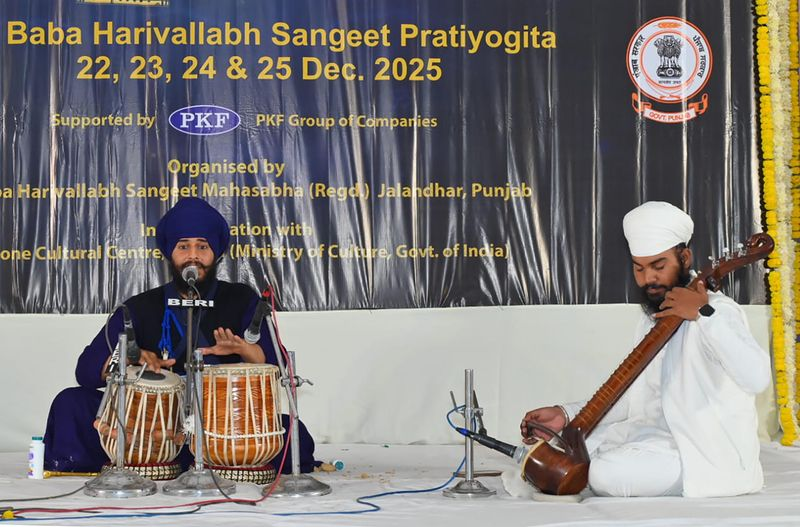
As the first notes of the shehnai drifted through the winter air in Jalandhar, the 150th edition of the Harivallabh Sangeet Sammelan unfolded at the Shaktipeeth of Shree Devi Talab Mandir, reaffirming a legacy that has endured for a century and a half. Accompanied by the meditative strains of sitar, cello, and folk-inflected vocals, the opening moments were less a performance and more a prayer — true to the spirit in which the festival was born.
Recognised as India’s oldest continuously held Hindustani classical music festival, Harivallabh is rooted in devotion rather than display. Long before it became a landmark on the cultural calendar, the grounds of Shree Devi Talab were known as a saint’s gaddi, echoing with hymns sung by learned sages. Historical accounts note that Maharaja Ranjit Singh granted nearly 2,400 bighas of land for the construction of the temple, further sanctifying the site that would later host this extraordinary tradition.
The origins of the sammelan date back to December 1875, when Baba Harivallabh commemorated the death anniversary of his guru, Swami Tuljagiri. Saints and ascetics gathered to sing dhrupad compositions in reverence to the Almighty and their spiritual forebears. What began as an act of remembrance gradually transformed into a confluence of spiritual seekers and musical scholars, drawing some of the most eminent figures of Indian classical music. Among the early luminaries to grace the festival was Pandit Vishnu Digambar Paluskar, who performed here in 1896.
Unlike modern music festivals, Harivallabh has never shed its sacred character. It is widely regarded not as a concert, but as an offering. Artists who perform here do so in humility, seeing their music as seva rather than spectacle. This ethos has helped preserve the festival’s unique identity across generations.
Equally significant is the sammelan’s syncretic spirit. From its earliest days, it has welcomed participants across religious traditions, with Hindus, Muslims, and Sikhs sharing the same stage and spiritual space. This inclusive philosophy has played a vital role in nurturing generations of maestros while reinforcing music as a unifying force beyond faith and form.
Time-honoured rituals continue to define the event. Only Indian classical music is performed. Each edition begins with a Havan Yagya, invoking blessings before the first raga is sung. At the conclusion of a performance, the artist is showered with marigold and rose petals in a ceremonial pushp varsha — a gesture of gratitude rather than applause.
As Harivallabh marks 150 years, it stands as a rare testament to continuity in a rapidly changing world. In an era of fleeting trends, this sacred gathering remains anchored in devotion, discipline, and shared cultural memory — a living reminder that some traditions do not merely survive time, they transcend it.