


AI Generated Summary
- In 2013, while he was still a year away from retirement, he arranged a motorcycle fitted with a cart and began travelling to langar sites to collect used thermocol plates and other discarded material.
- The cycle — from a plate used to serve food in a community kitchen to material enriching the soil — reflects the environmental philosophy that Ghulla has sought to bring into the practice of seva.
- Around 2012, he began approaching organisers of langars, particularly those held in the vicinity of the Golden Temple, requesting them to avoid thermocol plates and pay greater attention to the waste generated at the sites.
In a city where langar is woven into everyday life, Avtar Singh Ghulla has found his own way of serving the community — not by preparing or distributing food, but by dealing with what remains after the meal is over.
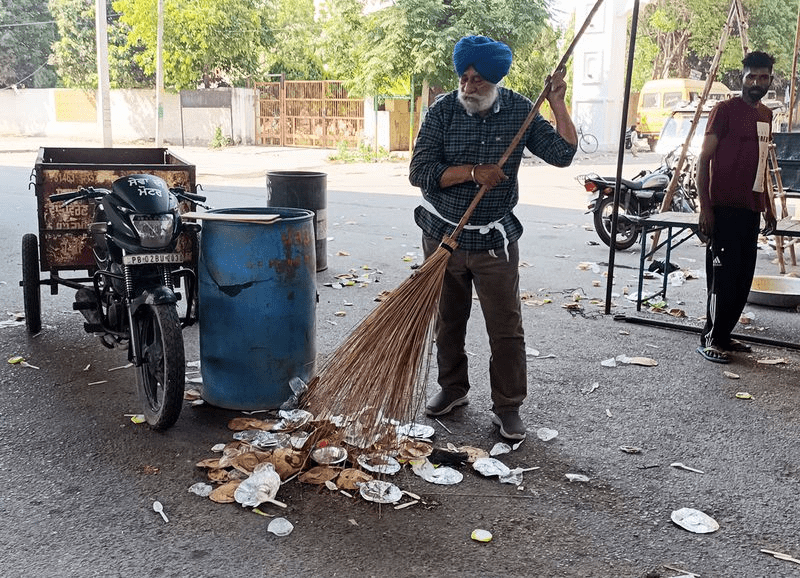
For more than a decade, the retired banker has been visiting langar sites in Amritsar, collecting discarded plates and other waste and ensuring that the venues are cleaned after the crowds leave. What began as a personal response to concerns over plastic pollution has gradually grown into an organised effort that has encouraged several langar organisers to reconsider the use of thermocol and other disposable materials.
Ghulla, a former manager with Punjab and Sind Bank, traces the beginnings of his environmental seva to discussions by former Akal Takht Jathedar Ranjit Singh on the damage caused by plastic to the environment. The message stayed with him and prompted him to consider what he could contribute at an individual level.
Around 2012, he began approaching organisers of langars, particularly those held in the vicinity of the Golden Temple, requesting them to avoid thermocol plates and pay greater attention to the waste generated at the sites. The response, however, was limited.
Rather than wait for others to act, Ghulla decided to take responsibility for the clean-up himself.
In 2013, while he was still a year away from retirement, he arranged a motorcycle fitted with a cart and began travelling to langar sites to collect used thermocol plates and other discarded material. Retirement subsequently gave him more time to expand the initiative.
But Ghulla’s efforts did not stop at removing waste. He began persuading organisers to replace thermocol plates with traditional biodegradable leaf plates, or pattals. The change presented another practical challenge: thousands of used pattals generated at a large langar had to be collected, compressed and transported efficiently.
Ghulla found a simple solution. He had a special steel-spiked implement fabricated that could pierce and compress hundreds of pattals together, allowing them to be bundled and transported in bulk.
A single langar, according to Ghulla, can leave behind between 5,000 and 7,000 pattals. Over the years, he estimates that around four to five lakh used leaf plates collected through the initiative have been sent to Pingalwara’s Green Manure project instead of ending up as ordinary waste.
There, the discarded pattals begin another journey. They are shredded and combined with soil and cow dung and left to decompose, eventually returning to the earth as organic matter.
The cycle — from a plate used to serve food in a community kitchen to material enriching the soil — reflects the environmental philosophy that Ghulla has sought to bring into the practice of seva.
His sustained campaign has also produced changes at the source. Several langar organisers in Amritsar have stopped using thermocol plates and shifted to biodegradable pattals.
Ghulla does not, however, see steel utensils as the obvious solution for every large-scale langar. He points to the substantial quantity of water required to wash thousands of plates, along with the detergents needed for cleaning them. For him, biodegradable leaf plates offer a practical alternative where reusable utensils may involve significant water consumption.
What was once largely an individual effort now has more hands behind it. Around 15 volunteers associated with the Ekjot Langar Sewa Society assist Ghulla in collecting waste and carrying out the initiative.
His philosophy of service remains straightforward. Not everyone, he believes, needs to contribute to a langar in the same manner. While some have the resources to sponsor food and others can cook or serve it, his contribution begins when the meal is over.
“I do not have the financial capacity to organise a langar, but I can contribute through this form of seva,” Ghulla says.
The retired banker is also associated with the environment committee of the Chief Khalsa Diwan. His work has received recognition from the Punjab Government, the Municipal Corporation and religious organisations. He was also presented a certificate of appreciation by Punjab Chief Minister Bhagwant Mann at an Independence Day function in Ferozepur.
Yet the significance of Ghulla’s work lies as much in its routine nature as in the recognition it has received. Langars can feed thousands within hours; the waste they generate can remain far longer if it is not responsibly managed.
By turning the clean-up after a community meal into an act of service in its own right, Ghulla has spent more than a decade demonstrating that hospitality need not end when the last plate has been served. Seva, in his case, continues until the ground is clean — and what can return to the earth is sent back to it.