


AI Generated Summary
- “Since our Gurbani Kirtan is not accompanied by the rabab and other string instruments, we have lost the spiritual connection which was the basis of introducing the string instrument with Gurmat Sangeet,” he says.
- At a Sangrur academy, learners from seven to 70 are being introduced to the rabab, saranda, taus, dilruba and other traditional instruments — keeping alive a musical inheritance closely intertwined with Gurbani and Gurmat Sangeet.
- Established in November 2023, the academy has grown into a centre for teaching traditional string instruments, or Tanti Saaz, with a particular emphasis on their place in Sikh musical heritage.
At a Sangrur academy, learners from seven to 70 are being introduced to the rabab, saranda, taus, dilruba and other traditional instruments — keeping alive a musical inheritance closely intertwined with Gurbani and Gurmat Sangeet.
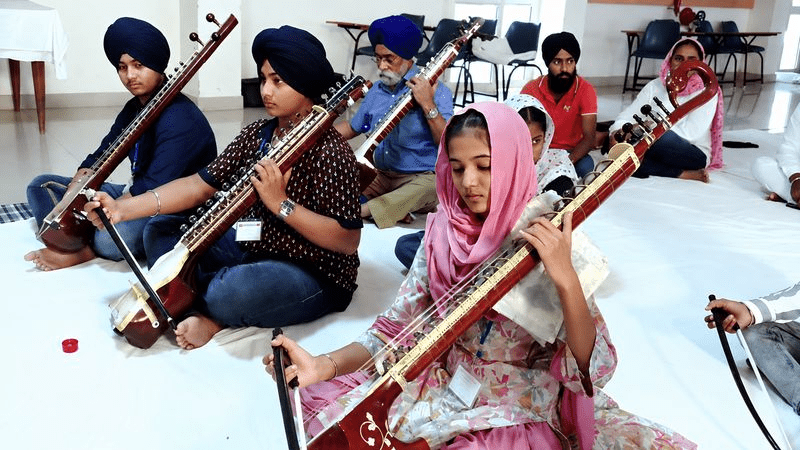
In a classroom in Sangrur, an unusual musical conversation is taking place across generations. Children barely old enough to hold an instrument sit alongside college students and older learners, some in their seventies. In their hands are instruments whose histories stretch back centuries — the rabab, saranda, taus, dilruba and sarangi.
At a time when keyboards, synthesisers and electronically produced sounds increasingly shape contemporary music, the Akal Tanti Saaz Academy is attempting something decidedly different: returning musicians to the strings.
Established in November 2023, the academy has grown into a centre for teaching traditional string instruments, or Tanti Saaz, with a particular emphasis on their place in Sikh musical heritage. Around 40 students currently learn here, and neither their lessons nor their instruments and workshops come with a price tag.
Behind the initiative is Karanvir Singh Sibia, president of the Akal Group of Institutes, Sangrur, whose own entry into this musical world was somewhat unexpected.
Sibia did not grow up as a musician. His interest deepened while he was associated with filmmaker Dr Harjit Singh on a documentary about the rabab. The project, he recalls, prompted him to look more closely at the relationship between Guru Nanak Dev, Bhai Mardana and music.
“I was able to understand the nuances of music and why Guru Nanak Dev chose the rabab and Bhai Mardana for his Udasis,” says Sibia.
That association occupies an important place in Sikh musical memory. Bhai Mardana, Guru Nanak Dev’s lifelong companion, was a musician who played the rabab as he accompanied the Guru on his travels. The sound of the instrument consequently became intimately connected with the singing of the Guru’s compositions.
It also points towards a larger tradition in which music was much more than an embellishment to the word.
The Sikh scriptural and musical tradition developed an intricate relationship with raag. The Adi Granth, compiled under Guru Arjan Dev, is organised in significant part through a musical framework that includes 31 principal raags. Within this tradition, melody, poetry and spiritual expression were conceived not as separate elements, but as parts of a unified experience.
String instruments were particularly suited to this musical vocabulary. Instruments such as the rabab, saranda, taus and dilruba could sustain a note and move fluidly from one sur to another, allowing their sound to follow and complement the human voice.
Over time, however, their presence within popular forms of Gurbani Kirtan diminished as other instruments became more commonplace.
For Sibia, rediscovering the rabab consequently raised another question: could younger generations be encouraged not simply to know about these instruments, but actually to learn them?
“Since our Gurbani Kirtan is not accompanied by the rabab and other string instruments, we have lost the spiritual connection which was the basis of introducing the string instrument with Gurmat Sangeet,” he says.
The effort initially took shape through Rabaab-E-Roohaniyat, an organisation created to make traditional string instruments available to deserving students, particularly those who might otherwise be unable to afford them.
The Akal Tanti Saaz Academy followed, addressing another problem: even a student interested in learning such an instrument may struggle to find a teacher or institution offering specialised training.
The Sangrur academy now teaches not only rabab, saranda, taus, dilruba and sarangi, but also tabla, dhad and algoze. Training is conducted under Ustad Ranjit Singh, Bhai Gurpreet Singh and Ustad Pardeep Kumar.
Its learners are as diverse as the instruments themselves. The youngest is seven and the oldest 70. Schoolchildren and college students learn alongside people associated with gurdwaras and members of the Nihang community.
Making the programme free, Sibia says, was essential to widening that circle.
“Teaching classes, equipment and workshops are completely free of cost to encourage maximum participation, since most of our learners are from the weaker economic section,” he says.
Yet access is only the first challenge.
Traditional string instruments are demanding companions. Producing the right note is one thing; developing command over sur, movement and expression requires sustained riyaaz. For children balancing school, young people attending college and adults managing work and family responsibilities, maintaining that discipline can become difficult.
The academy has consequently introduced regular assignments, activities and a structured syllabus to ensure that learning continues beyond individual classes.
It is also taking the instruments outside the classroom.
Workshops and demonstrations are organised at colleges, educational institutions and religious establishments, where academy teams introduce audiences to instruments many may recognise by name but rarely encounter in performance.
That outreach is important because preservation, in this case, cannot happen inside a museum cabinet. An instrument survives as a musical tradition only when somebody continues to play it — and when another generation learns how to listen to it.
The academy’s ambitions, therefore, go beyond producing a handful of trained performers.
“Our vision, which is also our mission, is to travel and explain the relevance of the divine instruments and the impact they have on the human mind and soul,” says Sibia.
There is an intriguing continuity in that ambition. Centuries ago, the rabab travelled with Guru Nanak Dev and Bhai Mardana. Today, the instruments are travelling again — this time into classrooms, colleges and institutions, carried by students being introduced to an inheritance far older than themselves.
The survival of Tanti Saaz will ultimately depend on precisely such encounters. Traditions rarely disappear at a single moment; they recede gradually when instruments cease to be played, teachers cease to find pupils and sounds once familiar become increasingly distant.
In Sangrur, a seven-year-old picking up a rabab and a 70-year-old learning alongside that child offer a modest but meaningful counterpoint to that process.
For the Akal Tanti Saaz Academy, preserving the past does not mean freezing it in time. It means putting an old instrument into new hands — and allowing its strings to resonate once again.