


AI Generated Summary
- The fragrance of sandalwood is the incense, the wind is the fan, and all the vegetation of the earth are the flowers laid at Your feet.
- He reminded the gathered crowd that God could not be confined to a carved idol or a physical room—the Divine lives in every human heart and every corner of creation.
- “The sky is the salver, the sun and moon are the lamps, and the sphere of stars are the studded pearls.
In 1506 CE, after traversing thousands of miles on foot across Asia during his first Udasi (spiritual odyssey), Guru Nanak Dev Ji arrived at the sacred coastal town of Puri in Odisha. His journey brought him to the majestic Jagannath Temple—a sanctuary dedicated to Lord Jagannath, the “Lord of the Universe.”
What transpired during this encounter remains one of the most breathtaking moments in India’s spiritual history: a sublime confluence where human ritual surrendered to cosmic devotion.
The Clash of Quiet Reverence and Granduer
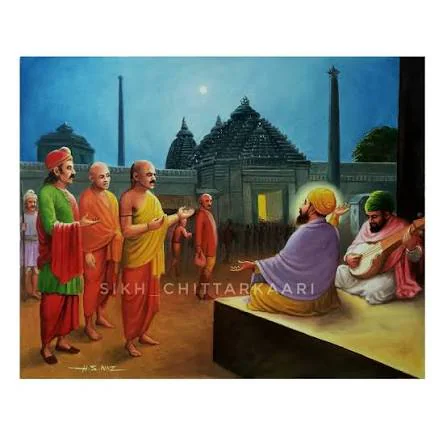
As dusk painted the skies over the Bay of Bengal, the temple’s sanctum roared to life. Priests in silk robes gathered for the evening Aarti—the sacred ritual of worship. Heavy brass platters held flickering oil lamps, rare pearls, fragrant sandalwood incense, and fresh flowers. The priests waved these offerings rhythmically before the deity while cymbals crashed and devout pilgrims fell to their knees.
Yet, amidst the fervor, Guru Nanak remained seated outside the ritual circle. Accompanied by his lifelong Muslim companion and musician, Bhai Mardana, the Guru sat in silent, luminous contemplation, gazing upward into the evening sky.
The temple priests were deeply offended. How could a traveling holy man refuse to bow or offer lamps to the Lord of the Universe? When questioned about his perceived disrespect, Guru Nanak smiled gently and looked out toward the endless ocean horizon.
He explained that he had not refused the Aarti—he was simply witnessing the grandest Aarti already taking place.
Gagan Mein Thaal: The Cosmic Hymn
Plucking the strings of the rabab, Bhai Mardana struck a haunting melody in Raga Dhanasri. Guru Nanak’s voice echoed across the temple courtyard as he sang what would become one of the most celebrated hymns in the Guru Granth Sahib: Gagan Mein Thaal.
“The sky is the salver, the sun and moon are the lamps, and the sphere of stars are the studded pearls. The fragrance of sandalwood is the incense, the wind is the fan, and all the vegetation of the earth are the flowers laid at Your feet…”
With these words, Guru Nanak dismantled the boundaries of traditional ritualism. Why offer tiny brass lamps to the Creator when the sun and moon already light the grandest altar ever built? Why wave peacock feathers when the evening sea breeze fans the globe?
Years later, Nobel laureate Rabindranath Tagore would reflect on this hymn, calling it the ultimate universal anthem of humanity—a masterpiece that transcends religion to honor the single, pulsating consciousness behind all existence.
The Shared Spirit of Puri
This meeting between Guru Nanak and the Jagannath tradition went far beyond poetry; it was a deep alignment of spiritual values. The Jagannath philosophy was uniquely radical for its era, rejecting rigid caste divisions by declaring that its sacred food, Mahaprasad, must be eaten together by all humans, king or pauper.
Guru Nanak’s revolutionary vision of Ik Onkar (One Universal Divine) and absolute human equality found fertile soil here. He reminded the gathered crowd that God could not be confined to a carved idol or a physical room—the Divine lives in every human heart and every corner of creation.
Before leaving Puri, Guru Nanak left a physical gift that endures to this day. Noticing the local population’s struggle with saline water near the beach, he dug a small freshwater well—Baoli Sahib—which continues to provide sweet water to coastal pilgrims five centuries later.
Guru Nanak’s visit to Puri remains a timeless reminder that while human rituals may divide us, the universe itself sings a single, unbroken melody of devotion.