


AI Generated Summary
- At a time when farm fires continue to contribute significantly to seasonal air pollution across northern India, the village has emerged as a model for sustainable crop residue management.
- Starting on a small portion of his land in 2016, he began incorporating paddy straw back into the soil instead of burning it.
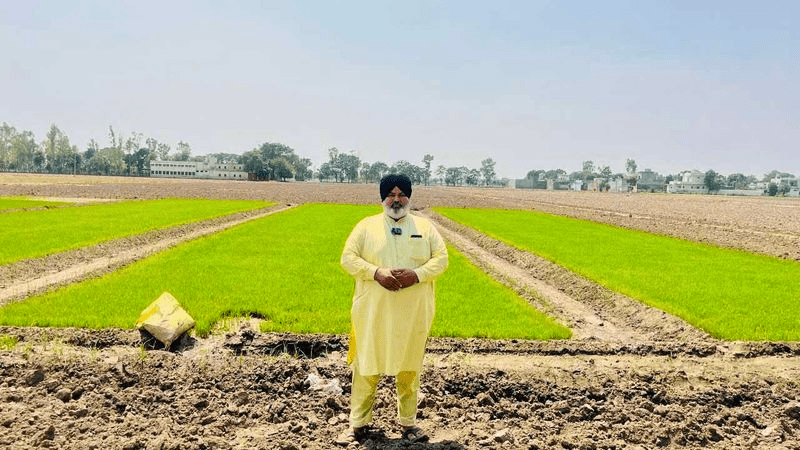
- The transformation of Jatana can largely be traced to the efforts of progressive farmer Amandeep Singh Mangat, whose willingness to adopt scientific agricultural practices gradually inspired an entire community to change its approach.
As Punjab’s paddy transplantation season gathers pace and concerns over post-harvest stubble burning begin to resurface, one village in Ludhiana district offers a compelling example of how collective action and scientific farming can tackle one of agriculture’s most persistent environmental challenges.
Jatana village in Khanna block has achieved something few rural communities in the state can claim: not a single reported case of stubble burning in the last six years. At a time when farm fires continue to contribute significantly to seasonal air pollution across northern India, the village has emerged as a model for sustainable crop residue management.
The transformation of Jatana can largely be traced to the efforts of progressive farmer Amandeep Singh Mangat, whose willingness to adopt scientific agricultural practices gradually inspired an entire community to change its approach.
Across the village, messages discouraging stubble burning are painted on walls, bus shelters and field structures. These reminders reflect a collective commitment that has become part of Jatana’s identity.
Mangat, who farms nearly 39 acres of owned and leased land, was not always an advocate of residue management. Like many farmers, he initially followed conventional cultivation methods. His outlook began to change after attending training programmes, farmer fairs and agricultural awareness camps organised by Punjab Agricultural University and the Krishi Vigyan Kendra (KVK), Samrala.
According to Mangat, sustained guidance from agricultural experts and support from development agencies encouraged him to experiment with modern techniques for managing paddy residue. Starting on a small portion of his land in 2016, he began incorporating paddy straw back into the soil instead of burning it.
The results were encouraging. Improved soil health, better crop performance and reduced input requirements convinced him to expand the practice across his entire farm.
A major breakthrough came when he compared traditional wheat cultivation with wheat sown using a Happy Seeder machine, which allows direct sowing without removing paddy residue. The comparison revealed multiple benefits, including lower weed growth, reduced irrigation requirements and higher productivity. The technology also helped cut field preparation expenses by an estimated Rs 2,000 to Rs 2,500 per acre.
Encouraged by these outcomes, Mangat steadily increased the area under Happy Seeder cultivation and by 2018 had adopted the method on a significant portion of his land.
His success soon influenced fellow farmers. With support from the CII Foundation, the village procured multiple Happy Seeders through subsidy programmes, making the technology accessible to a larger farming community. As adoption increased, stubble burning gradually disappeared from Jatana’s fields.
Today, the village possesses a range of crop-residue management equipment, including Happy Seeders, Super Seeders and reversible ploughs, enabling farmers to manage straw efficiently without resorting to fire.
Jatana’s achievements have attracted national attention. Teams from the Union Ministry of Agriculture and the Commission for Air Quality Management have visited the village to study its successful transition away from stubble burning.
The impact has extended beyond village boundaries. Farmers in neighbouring villages such as Begowal, Mehdoodan, Araichan and Chak Sarwan Nath have also begun adopting residue-management practices, supported by the availability of machinery through custom-hiring arrangements from Jatana.
For Mangat, whose annual farm income is estimated at around Rs 50 lakh, the benefits go beyond economics. Improved soil fertility, lower fertiliser consumption and better water conservation have reinforced his belief that environmentally responsible farming can also be profitable.
Agricultural experts point to Jatana as evidence that the stubble-burning problem can be addressed through awareness, access to technology and community participation rather than enforcement alone.
As Punjab prepares for another crop cycle and the annual debate over farm fires returns, Jatana’s experience demonstrates that sustainable alternatives are not only possible but practical. The village’s journey offers a roadmap for others seeking to protect both agricultural productivity and environmental health.
For Mangat, the message remains straightforward: adopting modern residue-management technologies today is essential for safeguarding the soil, water and air that future generations will depend on.