


AI Generated Summary
- The renaming was widely welcomed by followers of the saint and members of the Ravidas community, who viewed the gesture as a recognition of his enduring message of equality, compassion, and social justice.
- The new terminal, developed as a joint venture between the Airports Authority of India and the Punjab Government at a cost of ₹54.
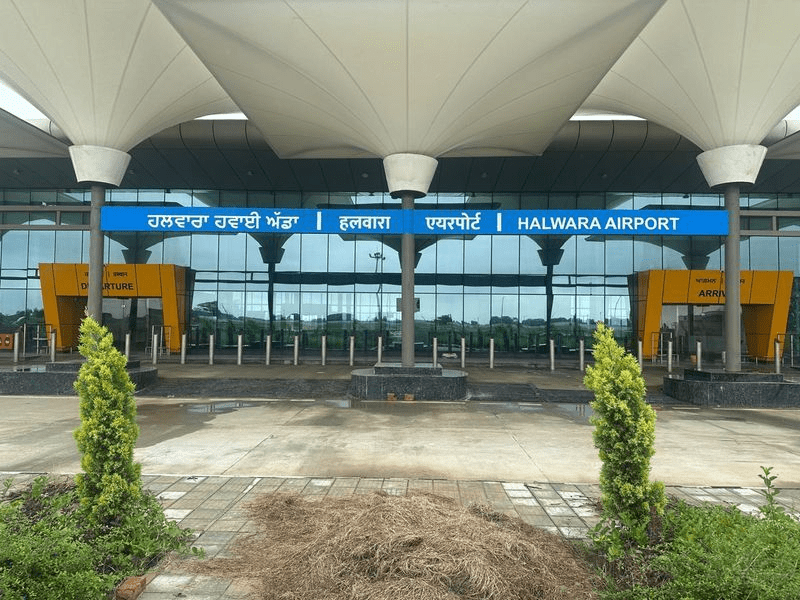
- Ludhiana and the surrounding Malwa region marked a historic moment yesterday as the new terminal building at Halwara Airport was virtually inaugurated, finally bringing long-awaited commercial air connectivity to Punjab’s industrial heartland.
Ludhiana and the surrounding Malwa region marked a historic moment yesterday as the new terminal building at Halwara Airport was virtually inaugurated, finally bringing long-awaited commercial air connectivity to Punjab’s industrial heartland. The development came after nearly 30 years of planning, delays, and sustained efforts to provide the region with a functional civil aviation facility.
The new terminal, developed as a joint venture between the Airports Authority of India and the Punjab Government at a cost of ₹54.67 crore, stood as a modern and sustainable structure spread across about 2,000 square metres. Designed to handle growing regional air traffic, the facility was equipped to accommodate Code C aircraft such as Airbus A321 and Boeing 737.
Alongside the inauguration, Adampur Airport was formally renamed Sri Guru Ravidas Ji Airport, Adampur, coinciding with the birth anniversary celebrations of Guru Ravidas. The renaming was widely welcomed by followers of the saint and members of the Ravidas community, who viewed the gesture as a recognition of his enduring message of equality, compassion, and social justice.
Aviation officials said the operationalisation of Halwara Airport was expected to significantly improve connectivity in the Malwa region. The airport was projected to handle around 300 passengers during peak hours and up to two lakh passengers annually. Security clearance had already been granted by the Bureau of Civil Aviation Security, and Air India had received the necessary permissions from the Indian Air Force. Flight operations were expected to begin in the first week of March 2026.
For Ludhiana, a major manufacturing and export centre, the airport inauguration was seen as a turning point. Business leaders and exporters had long argued that the absence of a nearby commercial airport increased travel time and logistics costs, placing the city at a disadvantage. The new facility was expected to ease movement for industry, attract fresh investment, and strengthen the city’s position as a national manufacturing hub.
Beyond industry, the airport was also expected to benefit tourism, healthcare, and education by making the region more accessible to visitors, patients, and students from across the country. Local transport operators, hospitality businesses, and service providers anticipated increased activity as passenger traffic grew.
The Halwara project had remained stalled for decades due to land acquisition hurdles and coordination issues among various agencies. Its completion was widely regarded as the result of persistent follow-up and improved coordination between central and state authorities.
Even as celebrations marked the inauguration, some voices reiterated the demand that Halwara Airport be named after freedom fighter Kartar Singh Sarabha. The Punjab Vidhan Sabha had earlier passed a unanimous resolution supporting the proposal, though the airport currently continued to be known as Halwara Airport.
Residents across Ludhiana and nearby districts described the occasion as a long-overdue milestone. Many expressed hope that regular flight services would soon connect the region directly with major cities, ushering in a new phase of growth and opportunity for Punjab’s industrial heartland.
