


AI Generated Summary
- For most of the world, Dera Baba Nanak entered popular consciousness with the opening of the Kartarpur Corridor, a rare humanitarian bridge allowing Sikh devotees access to the sacred gurdwara across the border in Pakistan’s Narowal district, where Guru Nanak Dev spent his final years.
- In a high-profile ceremony, Vice-President M Venkaiah Naidu laid the foundation stone at Dera Baba Nanak, an event attended by a galaxy of political leaders and marked by a brief moment of tension that was quickly defused.
- Revered for its spiritual gateway to Kartarpur, recognised for its fertile fields and remembered for a railway station that once connected undivided India to cities beyond the Ravi, the township today also grapples with less savoury realities of crime and insecurity.
In Punjab’s Gurdaspur district and touching the edge of the international border, Dera Baba Nanak is a town of layered identities. Revered for its spiritual gateway to Kartarpur, recognised for its fertile fields and remembered for a railway station that once connected undivided India to cities beyond the Ravi, the township today also grapples with less savoury realities of crime and insecurity.
For most of the world, Dera Baba Nanak entered popular consciousness with the opening of the Kartarpur Corridor, a rare humanitarian bridge allowing Sikh devotees access to the sacred gurdwara across the border in Pakistan’s Narowal district, where Guru Nanak Dev spent his final years. Locally, the corridor is often referred to simply as “the passage to Pakistan”. These days, however, that passage stands closed from the Indian side in the wake of Operation Sindoor, dampening the spirits of pilgrims even as facilities across the border remain functional.
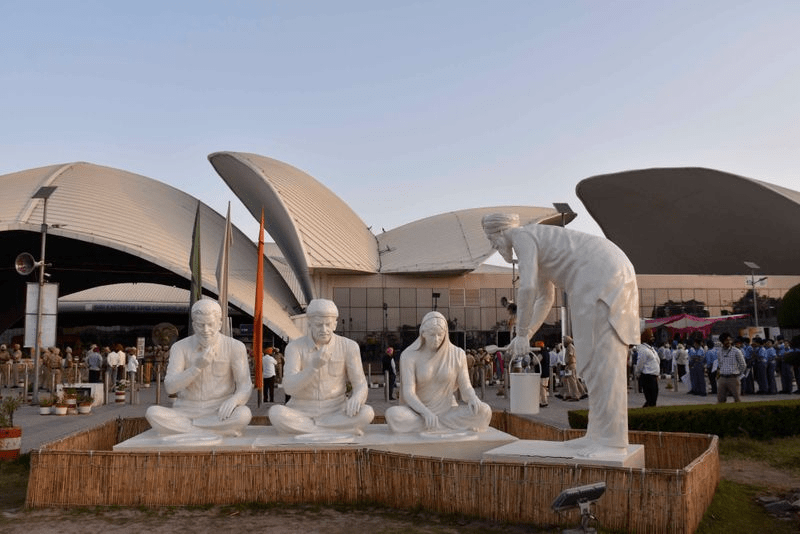
The story of the corridor is as political as it is devotional. In 2018, Pakistan’s then prime minister Imran Khan announced the project and swiftly completed construction on his side. With national elections looming in India, the move triggered hurried deliberations in New Delhi. The fear of political fallout among Sikh voters ensured that India’s share of the corridor was soon approved. In a high-profile ceremony, Vice-President M Venkaiah Naidu laid the foundation stone at Dera Baba Nanak, an event attended by a galaxy of political leaders and marked by a brief moment of tension that was quickly defused.
The corridor was formally inaugurated on November 9, 2019, coinciding with the 550th birth anniversary of Guru Nanak Dev. Former prime minister Manmohan Singh and his wife Gursharan Kaur were among the first pilgrims to cross over, joined by legislators from across Punjab’s political spectrum. Nearly 550 people formed the inaugural jatha, with the sitting MLA of Dera Baba Nanak accorded the honour of being the first to enter the newly built Integrated Check Post.
Despite its promise of welcoming up to 5,000 devotees daily, the corridor never saw the footfall it was designed for. In practice, only about 100 to 150 pilgrims crossed each day. The reason was procedural rather than political: the requirement of a valid passport. Many devotees, particularly from rural backgrounds, did not possess one. While politicians raised the issue repeatedly, the reality of international law left little room for flexibility. Though described as “visa-free”, the corridor still requires passport details to be logged into immigration systems.
Beyond faith and diplomacy, Dera Baba Nanak is equally known for what grows in its fields. The town’s cauliflowers enjoy an enviable reputation across Punjab. Women from nearby cities routinely travel here, often on free bus services, to buy the produce. Agricultural experts attribute the quality to the fertile alluvial soil enriched by the Ravi river and to farmers’ adoption of modern cultivation techniques. The result is a steady supply of premium vegetables to markets well beyond the district.
Yet the town’s pastoral calm has been disturbed in recent years by the shadow of organised crime. Rivalries between notorious gang leaders, particularly Jaggu Bhagwanpuria and foreign-based Balwinder Singh alias Donny Bal, have played out sharply in this border belt. Extortion calls have become commonplace, and political leaders have repeatedly flagged concerns over law and order. Even local electoral outcomes have been viewed through the prism of these underworld feuds.
Standing quietly amid these contrasts is Dera Baba Nanak’s iconic railway station. Built in 1927, it remains the last stop on the Indian side before Pakistan, the border just a short walk away. Before Partition, it bustled as a trading hub linking Punjab to Lahore, Sialkot and beyond. Today, it serves more as a reminder of shared histories than of active commerce.
In Dera Baba Nanak, devotion meets diplomacy, rich harvests coexist with fear, and history lingers in brick and steel. It is a town where the promise of connection and the reality of division are never far apart.
